MGATHER
指令示意图
简介
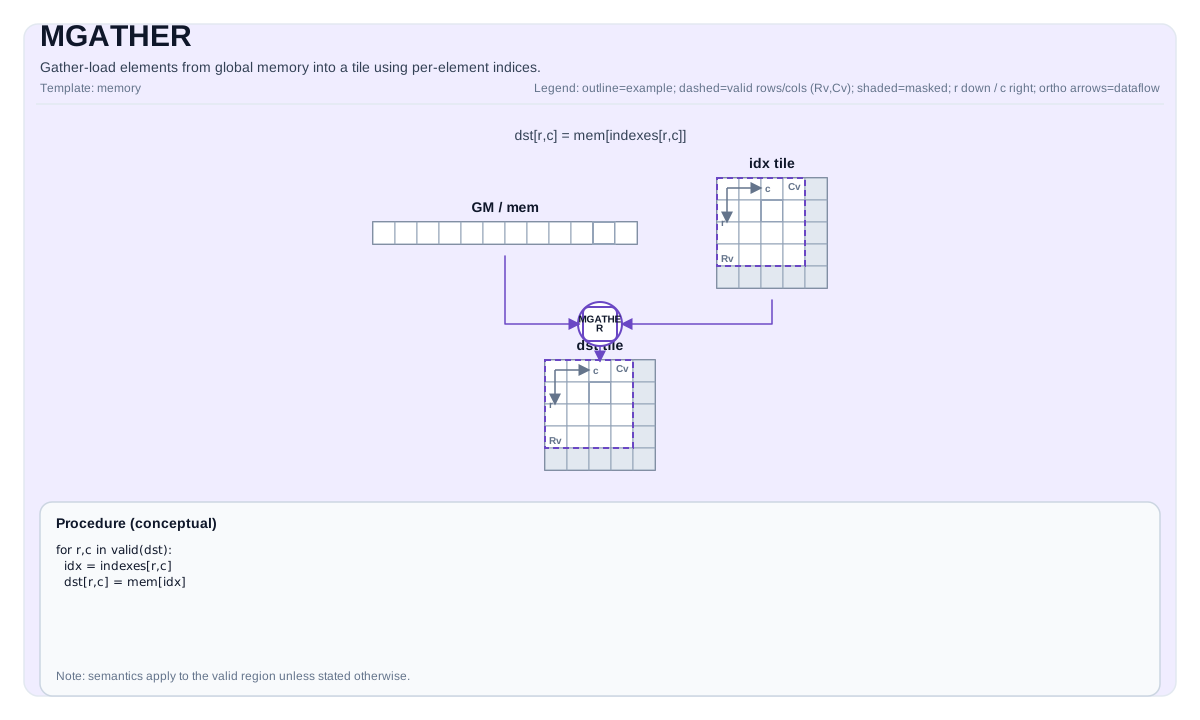
MGATHER 通过UB索引Tile从GM GlobalTensor 中读取数据到UB目标Tile。操作模式通过 Coalesce 模板参数显式选择:
Coalesce::Row(默认)——从table[idx[r], :]收集整行到dst[r, :]。索引tile是1-D形式([1, R]行主序;Ascend 950PR/Ascend 950DT上也支持[R, 1]列主序)。允许R = 1。Coalesce::Elem——通过idx[R, C]从一维化table收集元素到dst[R, C]。索引tile必须与目标具有相同的有效形状。允许退化的(1, 1)情况。
越界处理通过 GatherOOB 模板参数选择。MGATHER 没有原子或冲突策略:每个目标槽有唯一的源索引,因此不会发生冲突。
目标也可以是 L1 / cube TileType::Mat tile(NZ布局)(索引以GM tensor形式提供)。此GM → L1路径(支持 Coalesce::Row 和 Coalesce::Elem,适用于Atlas A2/A3 训练系列产品/Atlas A2/A3 推理系列产品和Ascend 950PR/Ascend 950DT)见下方 GM → L1 Gather(TileType::Mat目标) 章节。
按目标分发摘要:
- CPU模拟器 ——纯C++参考实现。遍历
validRow * validCol并读取table[idx[i, j]](Elem语义);CPU sim没有单独的Row coalesce路径。 - Atlas A2/A3 训练系列产品/Atlas A2/A3 推理系列产品VEC-CORE ——标量pipe驱动的单线程 / MTE2遍历。Row模式每行通过
tablePtr + safeIdx * tableRowStride发出一次宽copy_gm_to_ubuf_align_b*DMA;Elem模式每元素执行标量GM→UB拷贝。支持ND-GM与ND-UB以及NZ-GM与NZ-UB tile配对。 - Ascend 950PR/Ascend 950DT SIMT ——通过
cce::async_invoke以dim3{32, 32}(1024线程)进行SIMT启动。Row模式使用warp并行通道读取;Elem模式将每个通道映射到一个元素。Row内核将GM table视为打包ND(行步长 =validCols);MGatherCheck在编译时强制GlobalTable::staticShape[4] == TileDst::ValidCol。Ascend 950PR/Ascend 950DT不支持NZ块步长布局。退化的Elem(1, 1)情况绕过SIMT启动,在AIV向量核心上运行MGatherScalarImpl。
数学语义
Row Coalesce(Coalesce::Row)
目标 dst[R, C],索引 idx[1, R](Ascend 950PR/Ascend 950DT上也为 idx[R, 1]),表 table[TableRows, C]:
Element Coalesce(Coalesce::Elem)
目标 dst[R, C],索引 idx[R, C](与 dst 相同有效形状),一维表长度为 TableSize:
越界行为
enum class GatherOOB : uint8_t {
    Undefined = 0,  // 不检查边界;调用者保证索引有效
    Clamp     = 1,  // 将索引限制到 capacity - 1
    Wrap      = 2,  // 索引模 capacity
    Zero      = 3   // OOB 返回零;界内索引正常加载
};
汇编语法
同步形式:
%dst = mgather %mem, %idx : !pto.memref<...>, !pto.tile<...> -> !pto.tile<...>
AS Level 1(SSA)
%dst = pto.mgather %mem, %idx : (!pto.partition_tensor_view<MxNxdtype>, pto.tile<...>)
-> !pto.tile<loc, dtype, rows, cols, blayout, slayout, fractal, pad>
AS Level 2(DPS)
pto.mgather ins(%mem, %idx : !pto.partition_tensor_view<MxNxdtype>, !pto.tile_buf<...>) outs(%dst : !pto.tile_buf<...>)
C++内建接口
声明于 include/pto/common/pto_instr.hpp:
公共包含头为
<pto/pto-inst.hpp>,内部声明位于pto/common/pto_instr.hpp。
CPU参考形式
template <typename TileDst, typename GlobalData, typename TileInd, typename... WaitEvents>
PTO_INST RecordEvent MGATHER(TileDst &dst, GlobalData &src, TileInd &indexes, WaitEvents &... events);
Atlas A2/A3 训练系列产品/Atlas A2/A3 推理系列产品形式
template <Coalesce  CMode = Coalesce::Row,
          GatherOOB Oob   = GatherOOB::Undefined,
          typename TileDst, typename GlobalTable, typename TileIdx,
          typename... WaitEvents>
PTO_INST RecordEvent MGATHER(TileDst& dst, GlobalTable& table, TileIdx& idx,
                             WaitEvents&... events);
Ascend 950PR/Ascend 950DT形式
template <Coalesce  CMode = Coalesce::Row,
          GatherOOB Mode  = GatherOOB::Undefined,
          typename TileDst, typename GlobalData, typename TileInd,
          typename... WaitEvents>
PTO_INST RecordEvent MGATHER(TileDst& dst, GlobalData& table, TileInd& idx,
                             WaitEvents&... events);
参数(NPU形式)
dst—UB目标tile(TileType::Vec);形状[R, C]。table—源GMGlobalTensor。GlobalTensor::DType必须是__gm__ T,与目标元素类型匹配。idx—UB索引tile(TileType::Vec)。CMode—Coalesce值(Row或Elem)。作为第一个模板参数,操作模式在调用点始终显式指定。Oob/Mode—GatherOOB值,用于越界处理。
枚举
enum class Coalesce : uint8_t {
    Row  = 0,  // dst[r, :] = table[idx[r], :]   (长度为 R 的 1-D 索引)
    Elem = 1   // dst[i, j] = table[idx[i, j]]   (idx 形状 == dst 形状)
};

enum class GatherOOB : uint8_t {
    Undefined = 0,
    Clamp     = 1,
    Wrap      = 2,
    Zero      = 3
};
约束
Tile约束(CPU)
支持的数据类型:
dst/src元素类型必须是以下之一:int8_t、uint8_t、int16_t、uint16_t、int32_t、uint32_t、half、bfloat16_t、float。- 在AICore目标上(CPU模拟器以
__CCE_AICORE__编译时),还支持float8_e4m3_t和float8_e5m2_t。 indexes元素类型必须是int32_t或uint32_t。
Tile与内存类型:
dst必须是向量Tile(TileType::Vec)。indexes必须是向量Tile(TileType::Vec)。dst和indexes必须使用行主序布局(BLayout::RowMajor + SLayout::NoneBox)。src必须是位于GM内存中的GlobalTensor。src必须使用Layout::ND。
形状约束:
dst.Rows == indexes.Rows。indexes的形状必须为[1, N](按行gather)或[N, M](按元素gather)。dst行宽必须满足32字节对齐,即dst.Cols * sizeof(T)必须是32的倍数。src的静态shape必须满足Shape<1, 1, 1, TableRows, RowWidth>。
Tile约束(Atlas A2/A3 训练系列产品/Atlas A2/A3 推理系列产品)
支持的数据类型:
dst/src元素类型必须是以下之一:int8_t、uint8_t、int16_t、uint16_t、int32_t、uint32_t、half、bfloat16_t。Atlas A2/A3 训练系列产品/Atlas A2/A3 推理系列产品不支持float8_e4m3_t、float8_e5m2_t、hifloat8_t。indexes元素类型必须是int32_t或uint32_t。
Tile与内存类型:
dst必须是向量Tile(TileDst::Loc == TileType::Vec)。indexes必须是向量Tile(TileIdx::Loc == TileType::Vec)。- 索引tile 始终 是
BLayout::RowMajor + SLayout::NoneBox(ND),无论表布局如何。 src必须是位于GM内存中的GlobalTensor;GlobalTable::DType == __gm__ T。- 目标tile的bulk + sub布局必须与表布局精确配对:
GlobalTable::layout == Layout::ND⇒TileDst是BLayout::RowMajor + SLayout::NoneBox。GlobalTable::layout == Layout::NZ⇒TileDst是BLayout::ColMajor + SLayout::RowMajor + SFractalSize == TileConfig::fractalABSize(= 512Byte)。
形状约束:
- 填充后的
TileDst::Cols * sizeof(T)必须在两种布局中均为32字节对齐。ValidRow/ValidCol不受此规则约束。 - 对于
Coalesce::Row:TileIdx::ValidRow == 1且TileIdx::ValidCol == TileDst::ValidRow。 - 对于
Coalesce::Elem:TileIdx::ValidRow == TileDst::ValidRow且TileIdx::ValidCol == TileDst::ValidCol。 - 两种模式均要求
TileDst::ValidRow >= 1且TileDst::ValidCol >= 1。 - NZ表额外要求
GlobalTable::staticShape[3] == FRACTAL_NZ_ROW(= 16)、GlobalTable::staticShape[4] == C0_SIZE_BYTE / sizeof(T)(= 32Byte / 元素宽度)、TileDst::Cols % (C0_SIZE_BYTE / sizeof(T)) == 0且TileDst::Rows % FRACTAL_NZ_ROW == 0。
Tile约束(Ascend 950PR/Ascend 950DT)
支持的数据类型:
dst/src元素类型必须是以下之一:int8_t、uint8_t、int16_t、uint16_t、int32_t、uint32_t、half、bfloat16_t、float。在__CCE_AICORE__构建中还包含hifloat8_t、float8_e4m3_t、float8_e5m2_t。indexes元素类型必须是int32_t或uint32_t。
Tile与内存类型:
dst必须是向量Tile(TileDst::Loc == TileType::Vec)。indexes必须是向量Tile(TileIdx::Loc == TileType::Vec)。- SIMT内核对UB tile的布局无感知:每次UB读写均通过
tile_offset_2d<TileX>(r, c),因此TileDst可以为BLayout::RowMajor或BLayout::ColMajor(搭配SLayout::NoneBox)。 src必须是位于GM内存中的GlobalTensor;GlobalTable::DType == __gm__ T。- GM表布局:仅
Layout::ND。 Ascend 950PR/Ascend 950DT SIMT内核将GM寻址为扁平行主序缓冲区,行步长硬编码为validCols;MGatherCheck强制GlobalTable::staticShape[4] == TileDst::ValidCol,因此表不能有任何行间填充。
形状约束:
- 填充后的
TileDst::Cols * sizeof(T)(RowMajor)或TileDst::Rows * sizeof(T)(ColMajor)必须32字节对齐。 - 对于
Coalesce::Row:索引tile的有效形状为[1, R](BLayout::RowMajor)或[R, 1](BLayout::ColMajor)。 - 对于
Coalesce::Elem:TileIdx::ValidRow == TileDst::ValidRow且TileIdx::ValidCol == TileDst::ValidCol。TileIdx的BLayout与TileDst无关。 - 两种模式均要求
TileDst::ValidRow >= 1且TileDst::ValidCol >= 1。Elem模式中退化的(1, 1)形状绕过SIMT启动。
动态运行时形状(Atlas A2/A3 训练系列产品/Atlas A2/A3 推理系列产品和Ascend 950PR/Ascend 950DT)
MGATHER 同时接受编译时和运行时动态形状:
Tile<…, RowMask, ColMask>中RowMask == -1及/或ColMask == -1将运行时有效范围存储在tile对象中;实现通过dst.GetValidRow()/dst.GetValidCol()读取。Shape<S0, S1, S2, S3, S4>/Stride<…>中一个或多个-1条目使用运行时尺寸构造;实现通过table.GetShape(GlobalTensorDim::DIM_*)读取。
MGatherCheck 中的静态断言以 if constexpr (DIM > 0) 为门控,仅对编译时已知维度生效。
示例:
constexpr auto kPadCols = 16;
using DstTileT    = Tile<TileType::Vec, float,    1, kPadCols, BLayout::RowMajor, -1, -1>;
using IdxTileT    = Tile<TileType::Vec, int32_t,  1, kPadCols, BLayout::RowMajor, -1, -1>;
using TableShape  = Shape<1, 1, 1, -1, -1>;
using TableStride = Stride<1, 1, 1, -1, -1>;

int64_t validCols = 9, d3 = 3, d4 = 10, srcStride3 = 10;
TableShape  tableShape(d3, d4);
TableStride tableStride(srcStride3, (int64_t)1);
GlobalTensor<float, TableShape, TableStride> tableGM(srcGm, tableShape, tableStride);

DstTileT dstTile(1, validCols);
IdxTileT idxTile(1, validCols);
TASSIGN(dstTile, dstUbOffsetBytes);
TASSIGN(idxTile, idxUbOffsetBytes);

MGATHER<Coalesce::Elem, GatherOOB::Undefined>(dstTile, tableGM, idxTile);
模式匹配
Atlas A2/A3 训练系列产品/Atlas A2/A3 推理系列产品和Ascend 950PR/Ascend 950DT上模式是显式的,不会自动检测。MGatherCheck 中的静态断言根据所选的 Coalesce 值验证提供的tile形状:
A2/A3:
  Coalesce::Row  : Idx.ValidRow == 1 && Idx.ValidCol == Dst.ValidRow
  Coalesce::Elem : Idx.ValidRow == Dst.ValidRow && Idx.ValidCol == Dst.ValidCol

A5:
  Coalesce::Row  : (Idx.ValidRow == 1 && Idx.ValidCol == Dst.ValidRow) ||
                   (Idx.ValidRow == Dst.ValidRow && Idx.ValidCol == 1)
  Coalesce::Elem : (Idx.ValidRow == Dst.ValidRow) && (Idx.ValidCol == Dst.ValidCol)
布局支持
| Tile / Tensor | CPU | Atlas A2/A3 训练系列产品/Atlas A2/A3 推理系列产品 | Ascend 950PR/Ascend 950DT |
|---|---|---|---|
TileDst (UB) —ND |
BLayout::RowMajor + SLayout::NoneBox only |
BLayout::RowMajor + SLayout::NoneBox |
BLayout::RowMajor 或 ColMajor,SLayout::NoneBox |
TileDst (UB) —NZ |
不支持 | BLayout::ColMajor + SLayout::RowMajor + SFractalSize == 512 |
不支持 |
TileIdx (UB) —Row |
行主序(Cols必须等于1) | [1, R] BLayout::RowMajor + SLayout::NoneBox |
[1, R] RowMajor 或 [R, 1] ColMajor |
TileIdx (UB) —Elem |
BLayout::RowMajor + SLayout::NoneBox |
[R, C] BLayout::RowMajor + SLayout::NoneBox |
任意 BLayout,与 TileDst 无关 |
GlobalTable (GM) —ND |
Layout::ND only |
Layout::ND(线性连续寻址) |
Layout::ND only;Row模式硬编码 tableRowStride = validCols |
GlobalTable (GM) —NZ |
不支持 | Layout::NZ;5-D Shape<B, BCols, BRows, 16, C0> |
不支持 |
NZ布局(Atlas A2/A3 训练系列产品/Atlas A2/A3 推理系列产品)
当 GlobalTable::layout == Layout::NZ 且 TileDst 是匹配的 BLayout::ColMajor + SLayout::RowMajor + SFractalSize = 512 tile时,MGATHER(Atlas A2/A3 训练系列产品/Atlas A2/A3 推理系列产品)运行专用的NZ路径(MGatherRowNzImpl、MGatherElemNzImpl)。
- 常量。
kC0 = C0_SIZE_BYTE / sizeof(T);kFRow = FRACTAL_NZ_ROW = 16。每个分形块为kFRow × kC0元素(= 512Byte)。 - 逻辑形状。 逻辑行 =
gShape2 * kFRow。逻辑列 =gShape0 * gShape1 * kC0。Row模式的OOB以逻辑行数进行限制/取模;Elem模式以总元素数进行。 - Row模式。 对每个逻辑行
r,内核将idx[r]映射到(srcBlockRow, srcRowInBlock),将r映射到(dstBlockRow, dstRowInBlock),然后对每个外层批次发出 一次多burst MTE2传输。当Oob == GatherOOB::Zero时,内核在DMA循环前对整个tile预填T(0)并跳过OOB行的DMA。 - Elem模式。 对每个
(r, c),内核将idx映射到(logicalRow, logicalCol) = (idx / nLogicalCols, idx % nLogicalCols),然后通过MGatherNZGmOffset转换为NZ物理偏移。遍历顺序为块列 → 行 → 块内列,确保连续写入目标连续32Byte UB块。
Pipe / 同步模型
Atlas A2/A3 训练系列产品/Atlas A2/A3 推理系列产品—显式pipe握手
调用者不需要插入任何额外屏障,只需在 MGATHER 之前使用标准的 TLOAD 后置 set_flag(PIPE_MTE2, PIPE_V) / wait_flag(PIPE_MTE2, PIPE_V) 对,将索引tile带到向量pipe上的干净状态。
| 阶段 | Pipe转换 | 保护内容 |
|---|---|---|
| 前导 (Row ND + Row NZ) | V→S、MTE3→S flag链 |
使索引tile对标量读取可见,并冲刷可能在标量循环开始前与UB重叠的任何待处理MTE3写入 |
| 前导 (Elem ND + Elem NZ) | V→S、MTE3→S、MTE2→S flag链 |
与Row相同,额外的 MTE2→S flag冲刷标量循环读取 idxPtr 前的任何飞行中的MTE2 burst |
| Row后置 (ND + NZ) | S→MTE2、MTE2→V、MTE2→MTE3、S→V、S→MTE3 flag链 |
确保标量→MTE2竞争解决,然后在下游消费者触摸目标tile前排空MTE2 DMA |
| Elem后置 (ND + NZ) | S→V、S→MTE2、S→MTE3 flag链 |
使标量UB写入对V、MTE2和MTE3可见 |
Ascend 950PR/Ascend 950DT—SIMT启动与V↔S握手
Ascend 950PR/Ascend 950DT实现将几乎整个pipe模型隐藏在 cce::async_invoke 之后。唯一显式的内核端握手在标量回退路径(MGatherScalarImpl,用于Elem (1, 1)):
| 阶段 | Pipe转换 | 保护内容 |
|---|---|---|
| 前导(标量回退) | set_flag(PIPE_V, PIPE_S) / wait_flag(PIPE_V, PIPE_S) |
在单元素gather前使索引tile对标量pipe可见 |
| 后置(标量回退) | set_flag(PIPE_S, PIPE_V) / wait_flag(PIPE_S, PIPE_V) |
将对标量UB的写入释放给下游向量操作 |
UB内存预算
Atlas A2/A3 训练系列产品/Atlas A2/A3 推理系列产品
AIV向量核心具有标准的CANN 192KB UB布局。MGATHER 不从内核内部分配任何UB scratch—唯一的UB消费者是调用者分配的目标tile和索引tile。
Ascend 950PR/Ascend 950DT
Ascend 950PR/Ascend 950DT SIMT内核在AIV向量核心上运行。所有用户tile必须适应AIV的256KB Unified Buffer,加上两个固定的运行时预留:8KB保留区域和Data Cache(最少32KB)。因此最大可用为:
max dynUBufSize = 256 KB - 8 KB - 32 KB - static_memory
                = 216 KB - static_memory
当使用 TASSIGN 手动放置tile时,编译器看到 static_memory ≈ 0,全部 216KB 可作为 dynUBufSize 使用。当工作集在默认预算下超过128KB时,通过 kernel_name<<<numBlocks, dynUBufSize, stream>>>(args...) 显式声明。
示例
自动(Auto)
#include <pto/pto-inst.hpp>

using namespace pto;

void example_auto() {
  using DstT = Tile<TileType::Vec, float, 16, 16>;
  using IdxT = Tile<TileType::Vec, int32_t, 16, 16>;
  DstT dst;
  IdxT idx;
  // src 是 GM 中的 GlobalTensor
  MGATHER(dst, src, idx);
}
手动(Manual)
#include <pto/pto-inst.hpp>

using namespace pto;

void example_manual() {
  using DstT = Tile<TileType::Vec, float, 16, 16>;
  using IdxT = Tile<TileType::Vec, int32_t, 16, 16>;
  DstT dst;
  IdxT idx;
  // src 是 GM 中的 GlobalTensor
  TASSIGN(dst, 0x1000);
  TASSIGN(idx, 0x2000);
  MGATHER(dst, src, idx);
}
Row Coalesce—Embedding Lookup(Atlas A2/A3 训练系列产品/Atlas A2/A3 推理系列产品或Ascend 950PR/Ascend 950DT)
#include <pto/pto-inst.hpp>

using namespace pto;

template <typename T, int R, int C, int TableRows>
AICORE void example_embedding_lookup(__gm__ T* tablePtr, __gm__ int32_t* idxPtr, __gm__ T* outPtr)
{
    using DstTile     = Tile<TileType::Vec, T,       R, C, BLayout::RowMajor, R, C>;
    using IdxTile     = Tile<TileType::Vec, int32_t, 1, R, BLayout::RowMajor, 1, R>;
    using TableShape  = Shape<1, 1, 1, TableRows, C>;
    using TableStride = Stride<1, 1, 1, C, 1>;
    using TableTensor = GlobalTensor<T, TableShape, TableStride>;
    using IdxShape    = Shape<1, 1, 1, 1, R>;
    using IdxStride   = Stride<1, 1, 1, R, 1>;
    using IdxTensor   = GlobalTensor<int32_t, IdxShape, IdxStride>;

    TableTensor tableGM(tablePtr);
    IdxTensor   idxGM(idxPtr);
    DstTile dst; TASSIGN(dst, 0x0000);
    IdxTile idx; TASSIGN(idx, 0x1000);

    TLOAD(idx, idxGM);
    set_flag(PIPE_MTE2, PIPE_V, EVENT_ID0);
    wait_flag(PIPE_MTE2, PIPE_V, EVENT_ID0);
    MGATHER<Coalesce::Row, GatherOOB::Clamp>(dst, tableGM, idx);
}
Element Coalesce—2-D随机访问
AICORE void example_elem_2d(__gm__ float* tablePtr, __gm__ int32_t* idxPtr)
{
    constexpr int R = 8, C = 32, TableSize = 256;

    using DstTile     = Tile<TileType::Vec, float,   R, C, BLayout::RowMajor, R, C>;
    using IdxTile     = Tile<TileType::Vec, int32_t, R, C, BLayout::RowMajor, R, C>;
    using TableShape  = Shape<1, 1, 1, 1, TableSize>;
    using TableStride = Stride<1, 1, 1, TableSize, 1>;
    using TableTensor = GlobalTensor<float, TableShape, TableStride>;

    TableTensor tableGM(tablePtr);
    DstTile dst; TASSIGN(dst, 0x0000);
    IdxTile idx; TASSIGN(idx, 0x0800);

    MGATHER<Coalesce::Elem, GatherOOB::Wrap>(dst, tableGM, idx);
}
Row Coalesce— [R, 1] ColMajor索引(Ascend 950PR/Ascend 950DT only)
AICORE void example_row_colidx(__gm__ half* tablePtr, __gm__ int32_t* idxPtr)
{
    constexpr int R = 8, C = 64, TableRows = 64;

    using DstTile     = Tile<TileType::Vec, half,    R, C, BLayout::RowMajor, R, C>;
    using IdxTile     = Tile<TileType::Vec, int32_t, R, 1, BLayout::ColMajor, R, 1>;
    using TableShape  = Shape<1, 1, 1, TableRows, C>;
    using TableStride = Stride<1, 1, 1, C, 1>;
    using TableTensor = GlobalTensor<half, TableShape, TableStride>;
    using IdxShape    = Shape<1, 1, 1, R, 1>;
    using IdxStride   = Stride<1, 1, 1, 1, 1>;
    using IdxTensor   = GlobalTensor<int32_t, IdxShape, IdxStride, Layout::DN>;

    TableTensor tableGM(tablePtr);
    IdxTensor   idxGM(idxPtr);
    DstTile dst; TASSIGN(dst, 0x0000);
    IdxTile idx; TASSIGN(idx, 0x1000);

    TLOAD(idx, idxGM);
    set_flag(PIPE_MTE2, PIPE_V, EVENT_ID0);
    wait_flag(PIPE_MTE2, PIPE_V, EVENT_ID0);
    MGATHER<Coalesce::Row, GatherOOB::Undefined>(dst, tableGM, idx);
}
Element Coalesce— (1, 1) 退化情况
AICORE void example_scalar(__gm__ float* tablePtr, __gm__ int32_t* idxPtr)
{
    constexpr int TableSize = 32;

    using DstTile     = Tile<TileType::Vec, float,   1, 8, BLayout::RowMajor, 1, 1>;
    using IdxTile     = Tile<TileType::Vec, int32_t, 1, 8, BLayout::RowMajor, 1, 1>;
    using TableShape  = Shape<1, 1, 1, 1, TableSize>;
    using TableStride = Stride<1, 1, 1, TableSize, 1>;
    using TableTensor = GlobalTensor<float, TableShape, TableStride>;

    TableTensor tableGM(tablePtr);
    DstTile dst; TASSIGN(dst, 0x0000);
    IdxTile idx; TASSIGN(idx, 0x0080);

    MGATHER<Coalesce::Elem>(dst, tableGM, idx);
}
汇编示例(ASM)
自动模式
# 自动模式:由编译器/运行时负责资源放置与调度。
%dst = pto.mgather %mem, %idx : (!pto.partition_tensor_view<MxNxdtype>, pto.tile<...>)
手动模式
# 手动模式:先显式绑定资源,再发射指令。
# 可选(当该指令包含 tile 操作数时):
# pto.tassign %arg0, @tile(0x1000)
# pto.tassign %arg1, @tile(0x2000)
%dst = pto.mgather %mem, %idx : (!pto.partition_tensor_view<MxNxdtype>, pto.tile<...>)
PTO汇编形式
%dst = mgather %mem, %idx : !pto.memref<...>, !pto.tile<...> -> !pto.tile<...>
# AS Level 2 (DPS)
pto.mgather ins(%mem, %idx : !pto.partition_tensor_view<MxNxdtype>, !pto.tile_buf<...>) outs(%dst : !pto.tile_buf<...>)
GM → L1 Gather(TileType::Mat目标) 
除上述GM → UB gather外,MGATHER 还支持直接收集索引选择的数据到 L1 / cube TileType::Mat tile(NZ fractal布局) 中。当 TileDst::Loc == TileType::Mat 时,自动选择GM → L1路径。
索引来源—GM
GM → L1变体将索引作为GM GlobalTensor(int32_t / uint32_t)提供。Row模式复用三参数形式;Elem模式需要第四个参数 scratch(GM workspace):
// Row — 三参数形式
template <Coalesce CMode = Coalesce::Row, GatherOOB Oob = GatherOOB::Undefined,
          typename MatTileDst, typename GlobalTable, typename GlobalIdx>
PTO_INST RecordEvent MGATHER(MatTileDst& dst, GlobalTable& table, GlobalIdx& idx);

// Elem — 四参数形式(含 GM scratch)
template <Coalesce CMode = Coalesce::Elem, GatherOOB Oob = GatherOOB::Undefined,
          typename MatTileDst, typename GlobalTable, typename GlobalIdx, typename GlobalScratch>
PTO_INST RecordEvent MGATHER(MatTileDst& dst, GlobalTable& table, GlobalIdx& idx,
                             GlobalScratch& scratch);
约束(MGatherCheckGm2L1,Atlas A2/A3 训练系列产品/Atlas A2/A3 推理系列产品和Ascend 950PR/Ascend 950DT)
- Dtypes。 Atlas A2/A3 训练系列产品/Atlas A2/A3 推理系列产品:
int8/uint8/int16/uint16/int32/uint32/half/bfloat16/float。Ascend 950PR/Ascend 950DT额外支持hifloat8/float8_e4m3/float8_e5m2。Row模式进一步要求sizeof(T) <= 4。 - 索引。
idx必须是GMGlobalTensor,类型为int32_t或uint32_t。 - 表。
GlobalTable::DType == __gm__ T,GlobalTable::layout == Layout::ND。 - Scratch(仅Elem)。
GlobalScratch::DType == __gm__ T。 - 目标。
TileDst::Loc == TileType::Mat,NZ形式(!isRowMajor && SFractal == SLayout::RowMajor && SFractalSize == 512),TileDst::Cols % (C0_SIZE_BYTE / sizeof(T)) == 0,TileDst::Rows % FRACTAL_NZ_ROW (16) == 0。
示例—Row gather到L1 NZ tile
template <typename T, int R, int C, int TableRows>
AICORE void example_gm2l1_row(__gm__ T* tablePtr, __gm__ int32_t* idxPtr)
{
    using TableShape  = Shape<1, 1, 1, TableRows, C>;
    using TableStride = Stride<1, 1, 1, C, 1>;
    using IdxShape    = Shape<1, 1, 1, 1, R>;
    using IdxStride   = Stride<1, 1, 1, R, 1>;
    GlobalTensor<T, TableShape, TableStride, Layout::ND> tableGM(tablePtr);
    GlobalTensor<int32_t, IdxShape, IdxStride, Layout::ND> idxGM(idxPtr);

    using DstTile = Tile<TileType::Mat, T, R, C, BLayout::ColMajor, R, C, SLayout::RowMajor, 512>;
    DstTile dst; TASSIGN(dst, 0x0);

    MGATHER<Coalesce::Row, GatherOOB::Clamp>(dst, tableGM, idxGM);   // GM (ND) -> L1 (NZ)
}
示例—Elem gather到L1 NZ tile(含GM scratch)
template <typename T, int R, int C, int TableSize>
AICORE void example_gm2l1_elem(__gm__ T* tablePtr, __gm__ int32_t* idxPtr, __gm__ T* scratchPtr)
{
    using TableShape   = Shape<1, 1, 1, 1, TableSize>;
    using TableStride  = Stride<1, 1, 1, TableSize, 1>;
    using IdxShape     = Shape<1, 1, 1, R, C>;
    using IdxStride    = Stride<1, 1, 1, C, 1>;
    using ScratchShape = Shape<1, 1, 1, 1, R * C>;
    using ScratchStride= Stride<1, 1, 1, R * C, 1>;
    GlobalTensor<T, TableShape, TableStride, Layout::ND> tableGM(tablePtr);
    GlobalTensor<int32_t, IdxShape, IdxStride, Layout::ND> idxGM(idxPtr);
    GlobalTensor<T, ScratchShape, ScratchStride, Layout::ND> scratchGM(scratchPtr);

    using DstTile = Tile<TileType::Mat, T, R, C, BLayout::ColMajor, R, C, SLayout::RowMajor, 512>;
    DstTile dst; TASSIGN(dst, 0x0);

    MGATHER<Coalesce::Elem, GatherOOB::Zero>(dst, tableGM, idxGM, scratchGM);
}
Ascend 950PR/Ascend 950DT only—SIMT executor for Elem GM → L1 (GatherExec::Simt)
Ascend 950PR/Ascend 950DT上Elem GM → L1路径有两个executor,通过第三个模板参数 GatherExec 选择:
enum class GatherExec : uint8_t { Scalar = 0, Simt = 1 };
GatherExec::Scalar(四参数形式的默认值)——cube核心通过标量加载遍历索引。GatherExec::Simt—— AIV向量核心通过SIMT内核并行化gather。
template <Coalesce CMode, GatherOOB Oob, GatherExec Exec, typename MatTileDst,
          typename GlobalTable, typename GlobalIdx, typename GlobalScratch>
PTO_INST RecordEvent MGATHER(MatTileDst& dst, GlobalTable& table, GlobalIdx& idx,
                             GlobalScratch& scratch);
template <typename T, int R, int C, int TableSize>
AICORE void example_gm2l1_elem_simt(__gm__ T* tablePtr, __gm__ int32_t* idxPtr, __gm__ T* scratchPtr)
{
    using TableShape   = Shape<1, 1, 1, 1, TableSize>;
    using TableStride  = Stride<1, 1, 1, TableSize, 1>;
    using IdxShape     = Shape<1, 1, 1, R, C>;
    using IdxStride    = Stride<1, 1, 1, C, 1>;
    using ScratchShape = Shape<1, 1, 1, 1, R * C>;
    using ScratchStride= Stride<1, 1, 1, R * C, 1>;
    GlobalTensor<T, TableShape, TableStride, Layout::ND> tableGM(tablePtr);
    GlobalTensor<int32_t, IdxShape, IdxStride, Layout::ND> idxGM(idxPtr);
    GlobalTensor<T, ScratchShape, ScratchStride, Layout::ND> scratchGM(scratchPtr);

    using DstTile = Tile<TileType::Mat, T, R, C, BLayout::ColMajor, R, C, SLayout::RowMajor, 512>;
    DstTile dst; TASSIGN(dst, 0x0);

    MGATHER<Coalesce::Elem, GatherOOB::Zero, GatherExec::Simt>(dst, tableGM, idxGM, scratchGM);
}
性能考量
Atlas A2/A3 训练系列产品/Atlas A2/A3 推理系列产品
- Row vs. Elem。 Row coalesce实现最佳聚合带宽。Elem coalesce每个活跃通道发出一条标量GM读取 + UB写入。
- 顺序标量循环(Elem)。 Atlas A2/A3 训练系列产品/Atlas A2/A3 推理系列产品以单线程顺序遍历
validRow * validCol个通道。 - DMA成本(Row)。 ND:每行一次
copy_gm_to_ubuf_align_b*调用。NZ:每个(逻辑行,批次)对一次调用。 - OOB成本。
Undefined免费;Clamp/Wrap每通道增加一次算术remap;Zero写入T(0)内联(Elem)或预零tile并跳过OOB行的DMA(Row)。
Ascend 950PR/Ascend 950DT
- 形状自适应启动。 SIMT网格大小根据解析的
validRows/validCols确定。 - OOB策略成本。
Undefined:零开销。Clamp/Wrap:每通道一次算术remap。Zero:每通道一次比较和选择。 - 模式/OOB无线程分支。 所有决策均为
if constexpr。 - Row vs. Elem带宽。 Row coalesce实现最佳聚合带宽;Elem coalesce每通道执行一次标量GM加载。