TCVT
Tile Operation Diagram
Introduction
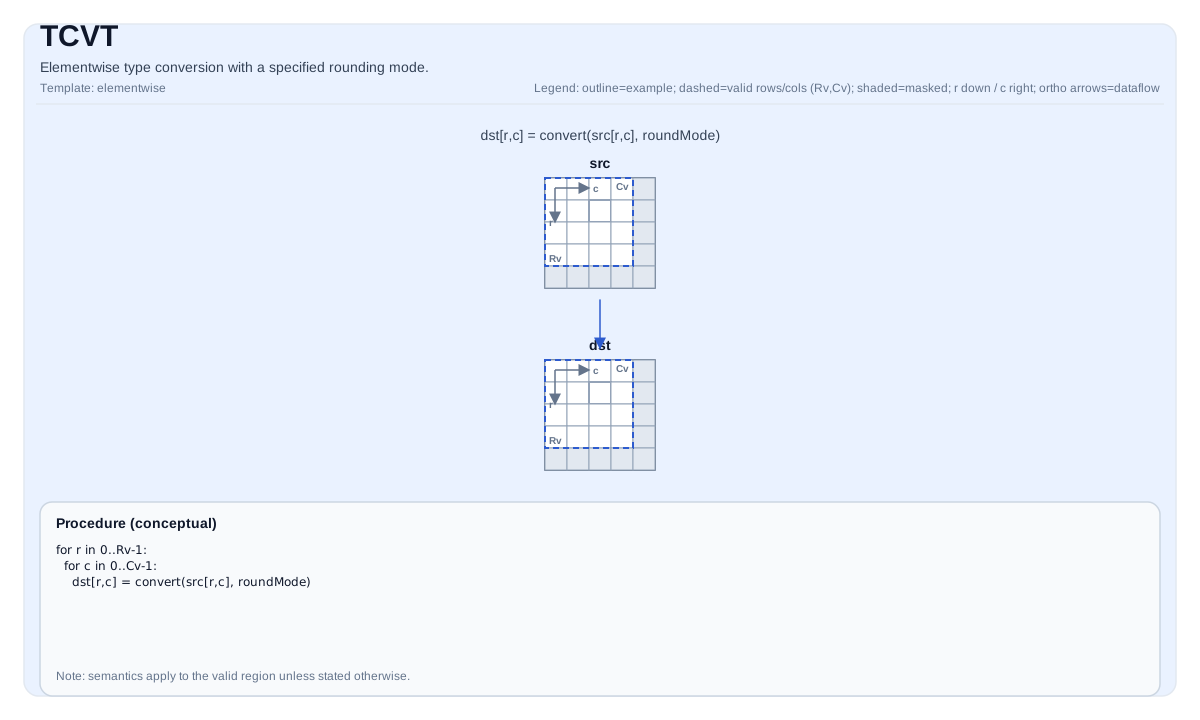
Elementwise type conversion with a specified rounding mode.
Math Interpretation
For each element (i, j) in the valid region:
\[ \mathrm{dst}_{i,j} = \mathrm{cast}_{\mathrm{rmode}}\!\left(\mathrm{src}_{i,j}\right) \]
where rmode is a rounding policy (see pto::RoundMode).
Assembly Syntax
Synchronous form:
%dst = tcvt %src {rmode = #pto.round_mode<CAST_RINT>} : !pto.tile<...> -> !pto.tile<...>
AS Level 1 (SSA)
%dst = pto.tcvt %src{rmode = #pto<round_mode xx>}: !pto.tile<...> -> !pto.tile<...>
AS Level 2 (DPS)
pto.tcvt ins(%src{rmode = #pto<round_mode xx>}: !pto.tile_buf<...>) outs(%dst : !pto.tile_buf<...>)
C++ Intrinsic
Declared in include/pto/common/pto_instr.hpp and include/pto/common/constants.hpp:
template <typename TileDataD, typename TileDataS, typename... WaitEvents>
PTO_INST RecordEvent TCVT(TileDataD &dst, TileDataS &src, RoundMode mode, SaturationMode satMode, WaitEvents &... events);

template <typename TileDataD, typename TileDataS, typename... WaitEvents>
PTO_INST RecordEvent TCVT(TileDataD &dst, TileDataS &src, RoundMode mode, WaitEvents &... events);

template <typename TileDataD, typename TileDataS, typename TmpTileData, typename... WaitEvents>
PTO_INST RecordEvent TCVT(TileDataD &dst, TileDataS &src, TmpTileData &tmp, RoundMode mode,
                          SaturationMode satMode, WaitEvents &... events);

template <typename TileDataD, typename TileDataS, typename TmpTileData, typename... WaitEvents>
PTO_INST RecordEvent TCVT(TileDataD &dst, TileDataS &src, TmpTileData &tmp, RoundMode mode,
                          WaitEvents &... events);
Constraints
dstandsrcmust be compatible in shape/valid region as required by the implementation.- The conversion
(src element type) -> (dst element type)must be supported by the target for the givenRoundMode. - Implementation notes (A2A3/A5):
- One form accepts an explicit
SaturationMode, and the specified saturation behavior is forwarded directly to the implementation. - The other form omits
SaturationMode; in that case, the implementation chooses a target-defined default saturation behavior for the specific type pair. - On CPU, only the form without explicit
SaturationModeis currently implemented.
- One form accepts an explicit
- Temporary tile:
- The C++ API provides overloads with an explicit
tmptile. On A2A3 this tmp tile is consumed by PyTorch-compatible non-saturating narrowing paths whenSaturationMode::OFFis used forfloat -> int16,half -> int16, orhalf -> int8. Other conversions do not require tmp space. - The implementation casts
tmptoint32_t *; size the tile by bytes, independent of the declaredTmpTileData::DType. - The formulas below give the minimum allocation size rounded to the 32-byte vector block granularity used by the implementation. If
C = 0, no tmp-backed conversion is issued and the required tmp size is0. - Common parameters:
R = dst.GetValidRow().C = dst.GetValidCol().SS = TileDataS::RowStride, in source elements.REPEAT_MAX = 255,REPEAT_BYTE = 256,BLOCK_BYTE_SIZE = 32.
float -> int16, non-saturating (SaturationMode::OFF):- The temporary result is an
int32_ttile produced by the firstfloat -> int32conversion step. floatsource rows are 32-byte aligned by the tile constraints, soSS / 8is the source repeat stride in 32-byte blocks.- For the aligned main region, one call processes one row and up to
REPEAT_MAXrepeats, with64elements per repeat: $$ \text{tmpHeadBytes} = 4 \times 64 \times \min\left(\left\lfloor\frac{C}{64}\right\rfloor, 255\right) $$ - For the tail region, one call processes up to
REPEAT_MAXrows using the source row stride. The extent is computed in 32-byte blocks because the vector repeat stride is block-based: $$ \text{tmpTailBytes} = \begin{cases} 32 \times \left((\min(R, 255) - 1) \times \frac{SS}{8} + \left\lceil\frac{C \bmod 64}{8}\right\rceil\right), & C \bmod 64 > 0 \ 0, & C \bmod 64 = 0 \end{cases} $$ - Minimum required tmp size for this path: $$ \text{tmpFloatToInt16Bytes} = \max(\text{tmpHeadBytes}, \text{tmpTailBytes}) $$
- A compact full-repeat upper bound for the main region is
REPEAT_MAX * REPEAT_BYTE = 65280bytes, but tail sizing can be larger whenSSis large because tail rows are written with source-row stride.
- The temporary result is an
half -> int16, non-saturating (SaturationMode::OFF):- The implementation processes each row in sub-chunks of at most
64elements and reuses the same temp buffer for every sub-chunk. ForC > 0, let: $$ H = \min(C, 64) $$ - Minimum required tmp size for this path: $$ \text{tmpHalfToInt16Bytes} = 32 \times \left\lceil\frac{H}{8}\right\rceil $$
- A shape-independent upper bound for any non-empty tile is
256bytes.
- The implementation processes each row in sub-chunks of at most
half -> int8, non-saturating (SaturationMode::OFF):- The implementation also processes sub-chunks of at most
64elements and reuses the same 256-byte temp region. The first step can write up to64int32_tvalues into bytes[0, 255]; after theint32 -> int16narrow, bytes[0, 127]hold theint16_tvalues and bytes[128, 255]are reused as scratch. tempMaskBuf = tempAndBuf + 64advances by64 * sizeof(int16_t) = 128bytes, so it points at the upper half of the same 256-byte temp region. It does not require an additional 256-byte allocation.- Minimum required tmp size for this path: $$ \text{tmpHalfToInt8Bytes} = \max\left(32 \times \left\lceil\frac{H}{8}\right\rceil,\ 128 + 32 \times \left\lceil\frac{H}{16}\right\rceil\right) $$
- A shape-independent upper bound for any non-empty tile is
256bytes.
- The implementation also processes sub-chunks of at most
- Overall minimum for all tmp-backed TCVT conversions:
- Since
tmpHalfToInt8Bytes >= tmpHalfToInt16Bytes, the minimum tmp size that fits all tmp-backed TCVT conversion paths for the same shape is: $$ \text{tmpSizeAllBytes} = \max(\text{tmpFloatToInt16Bytes},\ \text{tmpHalfToInt8Bytes}) $$ - Equivalently, if the tile is non-empty and a compact shape-independent bound for the half paths is acceptable: $$ \text{tmpSizeAllBytes} = \max(\text{tmpFloatToInt16Bytes},\ 256) $$
- Since
- The no-
tmpoverload remains valid for conversions that do not need the PyTorch-compatible tmp-backed path, or when native saturation behavior is sufficient.
Supported Conversions (Side-by-Side: A2A3 vs A5)
| Source Type | A2A3 Destinations | A5 Destinations | Difference |
|---|---|---|---|
| FP32 | FP16, FP32 (round-only), BF16, I16, I32, I64 | FP32, FP16, BF16, I16, I32, I64, FP8_E4M3, FP8_E5M2, H8 | A5 adds FP8/H8 targets |
| FP16 | FP32, I32, I16, I8, U8, S4 (int4b_t) | FP32, I32, I16, I8, U8, H8 | A2A3 has S4 path; A5 has H8 path |
| BF16 | FP32, I32 | FP32, I32, FP16, FP4_E1M2X2, FP4_E2M1X2 | A5 adds FP16/FP4 targets |
| I16 | FP16, FP32 | U8, FP16, FP32, U32, I32 | A5 adds U8/U32/I32 targets |
| I32 | FP32, I16, I64, FP16 (deq path) | FP32, I16, U16, I64, U8 | A2A3 supports I32 -> FP16 (half, deq); A5 does not |
| I64 | FP32, I32 | FP32, I32 | Same |
| U8 | FP16 | FP16, U16 | A5 adds U16 target |
| I8 | FP16 | FP16, I16, I32 | A5 adds I16/I32 targets |
| S4 (int4b_t) | FP16 | N/A | A2A3-only |
| U32 | N/A | U8, U16, I16 | A5-only source type |
| FP8_E4M3 | N/A | FP32 | A5-only source type |
| FP8_E5M2 | N/A | FP32 | A5-only source type |
| H8 | N/A | FP32 | A5-only source type |
| FP4_E1M2X2 | N/A | BF16 | A5-only source type |
| FP4_E2M1X2 | N/A | BF16 | A5-only source type |
Notes: - Key gap: A2A3 supports I32 -> FP16 (half) via deq path, while A5 has no I32 -> FP16 conversion. - On A5, FP16 -> FP8_E4M3 and FP16 -> FP8_E5M2 are not supported.
Examples
Auto
#include <pto/pto-inst.hpp>

using namespace pto;

void example_auto() {
  using SrcT = Tile<TileType::Vec, float, 16, 16>;
  using DstT = Tile<TileType::Vec, half, 16, 16>;
  SrcT src;
  DstT dst;
  TCVT(dst, src, RoundMode::CAST_RINT);
}
Manual
#include <pto/pto-inst.hpp>

using namespace pto;

void example_manual() {
  using SrcT = Tile<TileType::Vec, float, 16, 16>;
  using DstT = Tile<TileType::Vec, half, 16, 16>;
  SrcT src;
  DstT dst;
  TASSIGN(src, 0x1000);
  TASSIGN(dst, 0x2000);
  TCVT(dst, src, RoundMode::CAST_RINT);
}
ASM Form Examples
Auto Mode
# Auto mode: compiler/runtime-managed placement and scheduling.
%dst = pto.tcvt %src{rmode = #pto<round_mode xx>}: !pto.tile<...> -> !pto.tile<...>
Manual Mode
# Manual mode: resources must be bound explicitly before issuing the instruction.
# Optional for tile operands:
# pto.tassign %arg0, @tile(0x1000)
# pto.tassign %arg1, @tile(0x2000)
%dst = pto.tcvt %src{rmode = #pto<round_mode xx>}: !pto.tile<...> -> !pto.tile<...>
PTO Assembly Form
%dst = tcvt %src {rmode = #pto.round_mode<CAST_RINT>} : !pto.tile<...> -> !pto.tile<...>
# AS Level 2 (DPS)
pto.tcvt ins(%src{rmode = #pto<round_mode xx>}: !pto.tile_buf<...>) outs(%dst : !pto.tile_buf<...>)