TTRANS
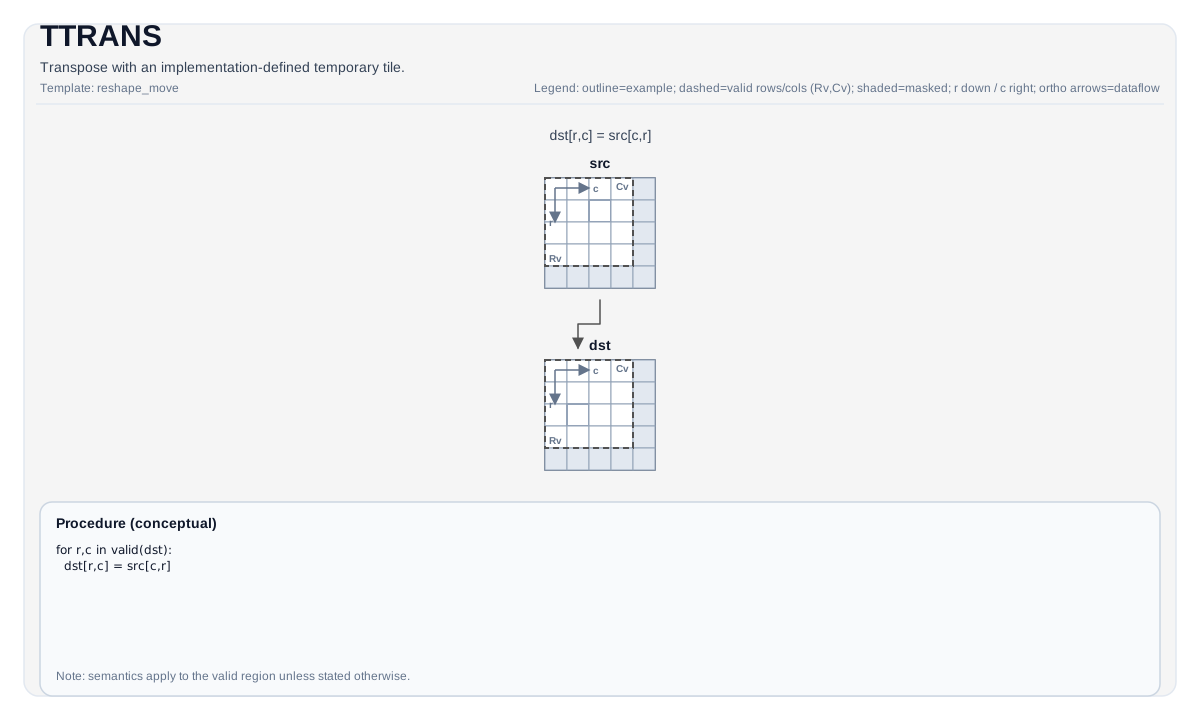
Tile Operation Diagram
Introduction
Transpose with an implementation-defined temporary tile.
Math Interpretation
For a 2D tile, over the effective transpose domain:
\[ \mathrm{dst}_{i,j} = \mathrm{src}_{j,i} \]
Exact shape/layout and the transpose domain depend on the target (see Constraints).
Assembly Syntax
Synchronous form:
%dst = ttrans %src : !pto.tile<...> -> !pto.tile<...>
Lowering may introduce internal scratch tiles; the C++ intrinsic requires an explicit tmp operand.
AS Level 1 (SSA)
%dst = pto.ttrans %src : !pto.tile<...> -> !pto.tile<...>
AS Level 2 (DPS)
pto.ttrans ins(%src : !pto.tile_buf<...>) outs(%dst : !pto.tile_buf<...>)
C++ Intrinsic
Declared in include/pto/common/pto_instr.hpp:
template <typename TileDataDst, typename TileDataSrc, typename TileDataTmp, typename... WaitEvents>
PTO_INST RecordEvent TTRANS(TileDataDst &dst, TileDataSrc &src, TileDataTmp &tmp, WaitEvents &... events);
Constraints
- Implementation checks (A2A3):
sizeof(TileDataSrc::DType) == sizeof(TileDataDst::DType).- Source layout must be row-major (
TileDataSrc::isRowMajor). - Element size must be
1,2, or4bytes. - Supported element types are restricted per element width:
- 4 bytes:
uint32_t,int32_t,float - 2 bytes:
uint16_t,int16_t,half,bfloat16_t - 1 byte:
uint8_t,int8_t - The transpose size is taken from
src.GetValidRow()/src.GetValidCol().
- Implementation checks (A5):
sizeof(TileDataSrc::DType) == sizeof(TileDataDst::DType).- Source layout must be row-major (
TileDataSrc::isRowMajor). - 32-byte alignment constraints are enforced on the column dimension of both input and output (
TileDataSrc::Cols * sizeof(T) % 32 == 0andTileDataDst::Cols * sizeof(U) % 32 == 0). - Supported element types are restricted per element width:
- 4 bytes:
uint32_t,int32_t,float - 2 bytes:
uint16_t,int16_t,half,bfloat16_t - 1 byte:
uint8_t,int8_t - The transpose size is taken from
src.GetValidRow()/src.GetValidCol().
- Temporary tile:
- The C++ API requires
tmp. The tmp space size calculation formulas are as follows: - Basic parameters:
- RowStride: 32 for b8 types, 16 for b16/b32 types (corresponding to Y_ELEM_B8 and Y_ELEM_OTHER)
- ElemPerBlock: 32/sizeof(T), i.e., number of elements per 32-byte block
- b8: uint8_t/int8_t, b16: uint16_t/int16_t/half/bfloat16_t, b32: uint32_t/int32_t/float
- Alignment conditions:
- When stride meets alignment requirements (dstStride % RowStride == 0, srcStride % ElemPerBlock == 0, srcStride/ElemPerBlock <= 255), tmp is used for efficient transpose; otherwise, scalar copy is used without needing tmp.
- 2D Tile transpose [H, W] -> [W, H]: $$ \text{tmpSize} = W \times \lceil\frac{H}{\text{RowStride}}\rceil \times \text{RowStride} \times \text{sizeof(DType)} $$ where W is the column count (validCol), H is the row count (validRow). tmpStride must be aligned to RowStride. tmp is needed only when stride meets alignment conditions.
- NCHW <-> NC1HWC0 bidirectional conversion:
- Forward [N, C, H, W] -> [N, C1, H, W, C0]: $$ \text{tmpSize} = H \times W \times \lceil\frac{C0}{\text{RowStride}}\rceil \times \text{RowStride} \times \text{sizeof(DType)} $$ where C1 = (C + C0 - 1) / C0, transpose domain is C0 rows and H*W columns.
- Reverse [N, C1, H, W, C0] -> [N, C, H, W]: $$ \text{tmpSize} = C0 \times \lceil\frac{H \times W}{\text{RowStride}}\rceil \times \text{RowStride} \times \text{sizeof(DType)} $$ transpose domain is H*W rows and C0 columns.
- GNCHW <-> GNC1HWC0 bidirectional conversion:
- Forward [G, N, C, H, W] -> [G, N, C1, H, W, C0]: $$ \text{tmpSize} = H \times W \times \lceil\frac{C0}{\text{RowStride}}\rceil \times \text{RowStride} \times \text{sizeof(DType)} $$ where C1 = (C + C0 - 1) / C0, transpose domain is C0 rows and H*W columns.
- Reverse [G, N, C1, H, W, C0] -> [G, N, C, H, W]: $$ \text{tmpSize} = C0 \times \lceil\frac{H \times W}{\text{RowStride}}\rceil \times \text{RowStride} \times \text{sizeof(DType)} $$ transpose domain is H*W rows and C0 columns.
- NC1HWC0 -> FRACTAL_Z and GNC1HWC0 -> FRACTAL_Z:
- These two conversions do not require tmp space, they directly execute memory reorganization operations.
- NCDHW to Fractal_Z_3D [N, C, D, H, W] -> [D, C1, H, W, N1, N0, C0]: $$ \text{tmpSize} = (N \times C1 \times C0 \times H \times W + \max(N \times C1 \times C0 \times H \times W, H \times W \times \lceil\frac{C0}{\text{RowStride}}\rceil \times \text{RowStride})) \times \text{sizeof(DType)} $$ where C1 = (C + C0 - 1) / C0, N1 = (N + N0 - 1) / N0. RowStride is 32 for 8-bit data and 16 for 16/32-bit data. This conversion has two stages with different execution paths: first stage extracts NCDHW d-plane to NCHW format (needs NC1C0HW space for planePtr), second stage either writes result to secondPtr (needs NC1C0HW) or uses secondPtr as transpose tmp (needs HWceil(C0/RowStride)*RowStride). Since the path is chosen at runtime, secondPtr requires max of both sizes.
- The C++ API requires
- ConvTile:
- Transpose of ConvTile for
TileType::Vecis supported。 Element size must be1、2or4bytes. Supported element types areuint32_t、int32_t、float、uint16_t、int16_t、half、bfloat16_t、uint8_t、int8_t. - Format transformation from
NCHWtoNC1HWC0is supported, whileC1 == (C + C0 - 1)/C0,HW matches alignment constraint,which meansH*W*sizeof(T)%32==0. C0 meansc0_size, whichC0 * sizeof(T) == 32。C0 can also be 4. - Format transformation from
NC1HWC0toFRACTAL_Zis supported, whileN1 == (N + N0 - 1)/N0。N0 should be 16. - Format transformation from
NCDHWtoFRACTAL_Z_3Dis supported, with the destination shape[D * C1 * H * W, N1, N0, C0], whereC1 == (C + C0 - 1)/C0andN1 == (N + N0 - 1)/N0.N0is16.C0depends on element width:64for 4-bit data,32for 8-bit data,16for 16-bit data and8for 32-bit data. See the Temporary tile section above for the tmp size calculation formula.
- Transpose of ConvTile for
Examples
Auto
#include <pto/pto-inst.hpp>

using namespace pto;

void example_auto() {
  using SrcT = Tile<TileType::Vec, float, 16, 16>;
  using DstT = Tile<TileType::Vec, float, 16, 16>;
  using TmpT = Tile<TileType::Vec, float, 16, 16>;
  SrcT src;
  DstT dst;
  TmpT tmp;
  TTRANS(dst, src, tmp);
}
Manual
#include <pto/pto-inst.hpp>

using namespace pto;

void example_manual() {
  using SrcT = Tile<TileType::Vec, float, 16, 16>;
  using DstT = Tile<TileType::Vec, float, 16, 16>;
  using TmpT = Tile<TileType::Vec, float, 16, 16>;
  SrcT src;
  DstT dst;
  TmpT tmp;
  TASSIGN(src, 0x1000);
  TASSIGN(dst, 0x2000);
  TASSIGN(tmp, 0x3000);
  TTRANS(dst, src, tmp);
}
ASM Form Examples
Auto Mode
# Auto mode: compiler/runtime-managed placement and scheduling.
%dst = pto.ttrans %src : !pto.tile<...> -> !pto.tile<...>
Manual Mode
# Manual mode: resources must be bound explicitly before issuing the instruction.
# Optional for tile operands:
# pto.tassign %arg0, @tile(0x1000)
# pto.tassign %arg1, @tile(0x2000)
%dst = pto.ttrans %src : !pto.tile<...> -> !pto.tile<...>
PTO Assembly Form
%dst = ttrans %src : !pto.tile<...> -> !pto.tile<...>
# AS Level 2 (DPS)
pto.ttrans ins(%src : !pto.tile_buf<...>) outs(%dst : !pto.tile_buf<...>)