TCMPS
Tile Operation Diagram
Introduction
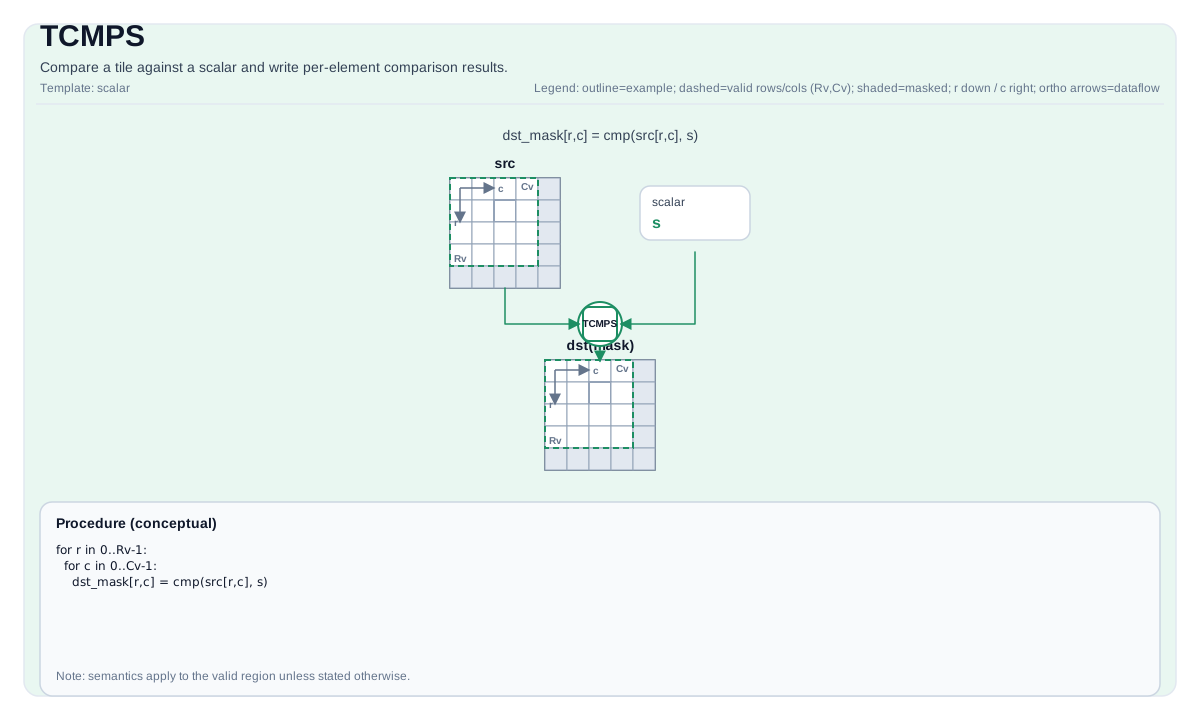
Compare a tile against a scalar or the first element of another tile and write per-element comparison results.
Two overloads are provided:
- Scalar form: compare every element of
src0against a scalar value. - Tile form: compare every element of
src0against the scalar from the first element ofsrc1tile.
Math Interpretation
Scalar form — for each element (i, j) in the valid region:
\[ \mathrm{dst}_{i,j} = \left(\mathrm{src0}_{i,j}\ \mathrm{cmpMode}\ \mathrm{scalar}\right) \]
Tile form — for each element (i, j) in the valid region:
\[ \mathrm{dst}_{i,j} = \left(\mathrm{src0}_{i,j}\ \mathrm{cmpMode}\ \mathrm{src1}_{0,0}\right) \]
The encoding/type of dst is implementation-defined (a bit-packed mask tile where each bit represents one comparison result).
Assembly Syntax
Synchronous form:
%dst = tcmps %src, %scalar {cmpMode = #pto.cmp<EQ>} : !pto.tile<...> -> !pto.tile<...>
AS Level 1 (SSA)
%dst = pto.tcmps %src, %scalar {cmpMode = #pto<cmp xx>} : (!pto.tile<...>, dtype) -> !pto.tile<...>
AS Level 2 (DPS)
pto.tcmps ins(%src, %scalar{cmpMode = #pto<cmp xx>}: !pto.tile_buf<...>, dtype) outs(%dst : !pto.tile_buf<...>)
C++ Intrinsic
Declared in include/pto/common/pto_instr.hpp and include/pto/common/type.hpp:
Scalar form — compare tile against a scalar:
template <typename TileDataDst, typename TileDataSrc, typename... WaitEvents,
          std::enable_if_t<all_events_v<WaitEvents...>, int> = 0>
PTO_INST RecordEvent TCMPS(TileDataDst& dst, TileDataSrc& src0,
                           typename TileDataSrc::DType src1, CmpMode mode,
                           WaitEvents&... events);
Tile form — compare tile against another tile (scalar broadcast from src1):
template <typename TileDataDst, typename TileDataSrc0, typename TileDataSrc1,
          typename... WaitEvents,
          std::enable_if_t<is_tile_data_v<TileDataSrc1> && all_events_v<WaitEvents...>, int> = 0>
PTO_INST RecordEvent TCMPS(TileDataDst& dst, TileDataSrc0& src0,
                           TileDataSrc1& src1, CmpMode mode,
                           WaitEvents&... events);
Constraints
- Implementation checks (A2A3):
TileData::DTypemust be one of:int32_t,float,half,uint16_t,int16_t.- Tile layout must be row-major (
TileData::isRowMajor). - For
int32_tinput, onlyCmpMode::EQis supported; other comparison modes fall back toEQ.
- Implementation checks (A5):
TileData::DTypemust be one of:int32_t,uint32_t,float,int16_t,uint16_t,half,uint8_t,int8_t,bfloat16_t.- Tile layout must be row-major (
TileData::isRowMajor).
- Common constraints:
- Tile location must be vector (
TileData::Loc == TileType::Vec) for bothsrcanddst. - Static valid bounds:
TileData::ValidRow <= TileData::RowsandTileData::ValidCol <= TileData::Cols. - Runtime:
src0anddstmust have the same valid row and column count. - Data type:
src0andsrc1must have the same data type.
- Tile location must be vector (
- Valid region:
- The op uses
src0.GetValidRow()/src0.GetValidCol()as the iteration domain.
- The op uses
- Comparison modes:
- Supports
CmpMode::EQ,CmpMode::NE,CmpMode::LT,CmpMode::GT,CmpMode::LE,CmpMode::GE.
- Supports
Examples
Auto
#include <pto/pto-inst.hpp>

using namespace pto;

void example_auto() {
  using SrcT = Tile<TileType::Vec, float, 16, 16>;
  using DstT = Tile<TileType::Vec, uint8_t, 16, 32, BLayout::RowMajor, -1, -1>;
  SrcT src;
  DstT dst(16, 2);
  TCMPS(dst, src, 0.0f, CmpMode::GT);
}
Manual
#include <pto/pto-inst.hpp>

using namespace pto;

void example_manual() {
  using SrcT = Tile<TileType::Vec, float, 16, 16>;
  using DstT = Tile<TileType::Vec, uint8_t, 16, 32, BLayout::RowMajor, -1, -1>;
  SrcT src;
  DstT dst(16, 2);
  TASSIGN(src, 0x1000);
  TASSIGN(dst, 0x2000);
  TCMPS(dst, src, 0.0f, CmpMode::GT);
}
Tile Form (compare against another tile)
#include <pto/pto-inst.hpp>

using namespace pto;

void example_tile() {
  using SrcT = Tile<TileType::Vec, float, 16, 16>;
  using DstT = Tile<TileType::Vec, uint8_t, 16, 32, BLayout::RowMajor, -1, -1>;
  SrcT src0, src1;
  DstT dst(16, 2);
  // src1[0,0] is used as the comparison scalar
  TCMPS(dst, src0, src1, CmpMode::GE);
}
ASM Form Examples
Auto Mode
# Auto mode: compiler/runtime-managed placement and scheduling.
%dst = pto.tcmps %src, %scalar {cmpMode = #pto<cmp xx>} : (!pto.tile<...>, dtype) -> !pto.tile<...>
Manual Mode
# Manual mode: resources must be bound explicitly before issuing the instruction.
# Optional for tile operands:
# pto.tassign %arg0, @tile(0x1000)
# pto.tassign %arg1, @tile(0x2000)
%dst = pto.tcmps %src, %scalar {cmpMode = #pto<cmp xx>} : (!pto.tile<...>, dtype) -> !pto.tile<...>
PTO Assembly Form
%dst = tcmps %src, %scalar {cmpMode = #pto.cmp<EQ>} : !pto.tile<...> -> !pto.tile<...>
# AS Level 2 (DPS)
pto.tcmps ins(%src, %scalar{cmpMode = #pto<cmp xx>}: !pto.tile_buf<...>, dtype) outs(%dst : !pto.tile_buf<...>)