TFILLPAD
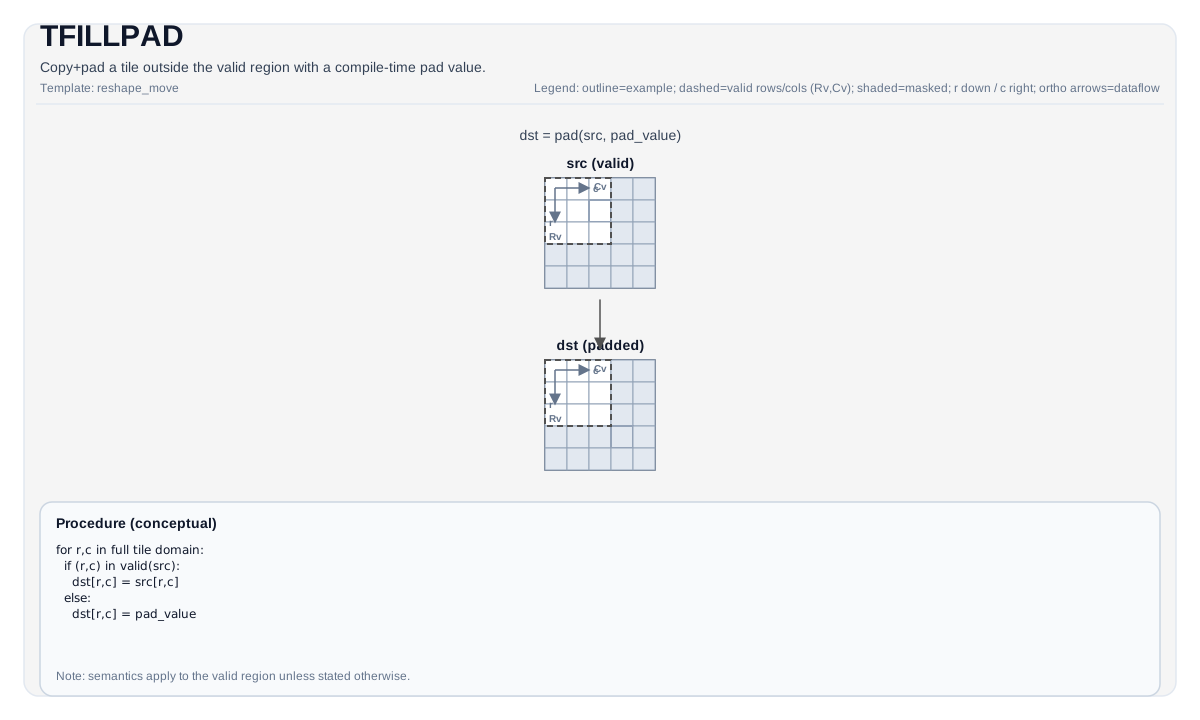
Tile Operation Diagram
Introduction
Copy a source tile into a destination tile and fill the remaining (padded) elements with a compile-time pad value
selected by TileDataDst::PadVal (e.g., PadValue::Min/PadValue::Max).
This is commonly used to materialize deterministic values outside the runtime valid region so that subsequent ops can operate on a full static tile shape.
Math Interpretation
Let VR = src.GetValidRow() and VC = src.GetValidCol(). For each destination element (i, j):
pad is determined by TileDataDst::PadVal and the element type (e.g., +inf/-inf for floating types when available,
otherwise std::numeric_limits<T>::max()/min()).
Assembly Syntax
Synchronous form (conceptual):
%dst = tfillpad %src : !pto.tile<...> -> !pto.tile<...>
AS Level 1 (SSA)
%dst = pto.tfillpad %src : !pto.tile<...> -> !pto.tile<...>
AS Level 2 (DPS)
pto.tfillpad ins(%src : !pto.tile_buf<...>) outs(%dst : !pto.tile_buf<...>)
C++ Intrinsic
Implemented in the backend headers pulled in by include/pto/common/pto_instr_impl.hpp:
template <typename TileData, PadValue PadVal = PadValue::Zero, typename... WaitEvents>
PTO_INST RecordEvent TFILLPAD(TileData &dst, TileData &src, WaitEvents &... events);

template <
    TFillPadMode mode = TFillPadMode::Normal,
    typename DstTileData,
    typename SrcTileData,
    typename... WaitEvents>
PTO_INST RecordEvent TFILLPAD(DstTileData &dst, SrcTileData &src, WaitEvents &... events);
For vector tiles, mode selects the operation variant:
TFillPadMode::Normal: destination and source static shapes must match.TFillPadMode::InPlace: destination and source must alias the same storage.TFillPadMode::Expand: destination may have a larger static shape than source.
TFILLPAD_INPLACE and TFILLPAD_EXPAND remain available as compatibility aliases.
Constraints
TileDataDst::PadVal != PadValue::Null(Vec-type overload).sizeof(TileDataDst::DType) == sizeof(TileDataSrc::DType)and element size must be1,2, or4bytes.TFILLPAD:TileDataDst::Rows/Colsmust matchTileDataSrc::Rows/Cols.TFILLPAD_EXPAND:TileDataDst::Rows >= TileDataSrc::RowsandTileDataDst::Cols >= TileDataSrc::Cols.TFILLPAD(TileData &dst, TileData &src)(Mat-type overload): whenTileData::TileTypeisMat, the layout must satisfy!TileData::isRowMajor && TileData::SLayout::RowMajor, andPadValmust bePadValue::ZeroorPadValue::Null. This Mat overload and the first Vec overload (PadVal != PadValue::Null) are separate SFINAE overloads, so the two are not contradictory.
Examples
#include <pto/pto-inst.hpp>

using namespace pto;

void example1() {
  using SrcT = Tile<TileType::Vec, float, 16, 16>;
  using DstT = Tile<TileType::Vec, float, 16, 16, BLayout::RowMajor, 16, 16, SLayout::NoneBox, TileConfig::fractalABSize, PadValue::Min>;

  SrcT src;
  DstT dst;
  TFILLPAD(dst, src);
}

void example2() {
  using TileMatData = Tile<TileType::Mat, float, 16, 256, BLayout::ColMajor, 1, 224, SLayout::RowMajor, 512>;

  TileMatData matTile;
  TFILLPAD(matTile, matTile);
}
ASM Form Examples
Auto Mode
# Auto mode: compiler/runtime-managed placement and scheduling.
%dst = pto.tfillpad %src : !pto.tile<...> -> !pto.tile<...>
Manual Mode
# Manual mode: resources must be bound explicitly before issuing the instruction.
# Optional for tile operands:
# pto.tassign %arg0, @tile(0x1000)
# pto.tassign %arg1, @tile(0x2000)
%dst = pto.tfillpad %src : !pto.tile<...> -> !pto.tile<...>
PTO Assembly Form
%dst = pto.tfillpad %src : !pto.tile<...> -> !pto.tile<...>
# AS Level 2 (DPS)
pto.tfillpad ins(%src : !pto.tile_buf<...>) outs(%dst : !pto.tile_buf<...>)