TCI
Tile Operation Diagram
Introduction
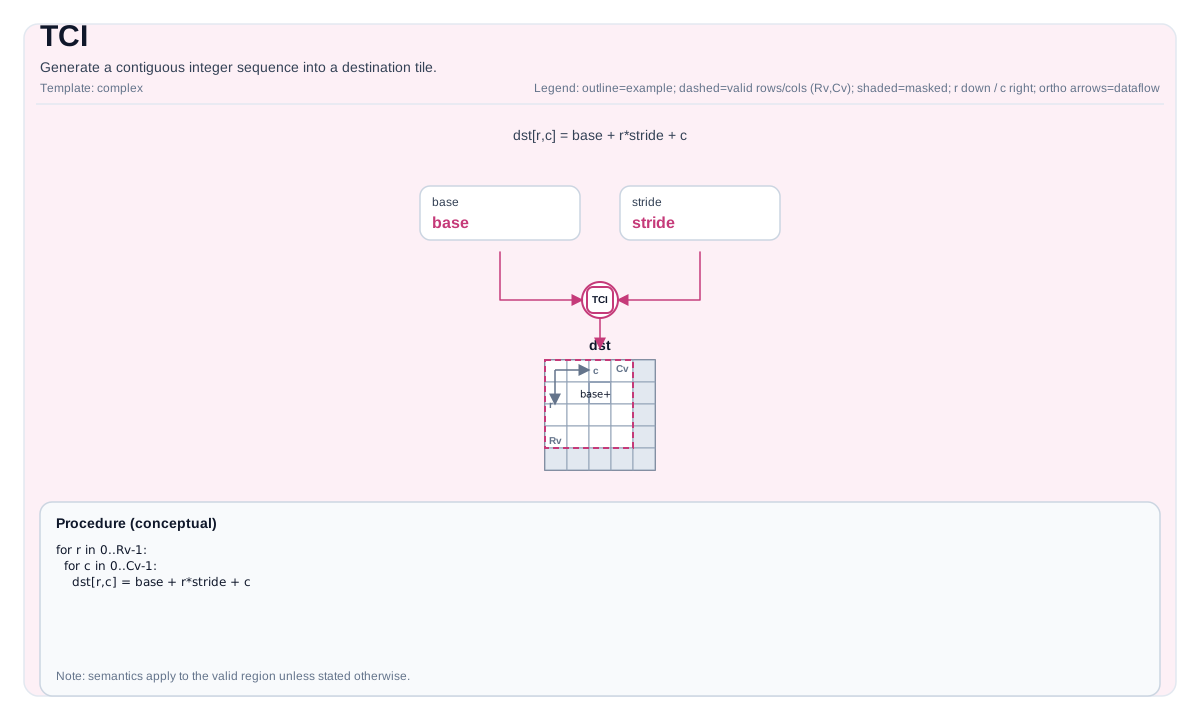
Generate a contiguous integer sequence into a destination tile.
Math Interpretation
For a linearized index k over the valid elements:
- Ascending:
$$ \mathrm{dst}_{k} = S + k $$
- Descending:
$$ \mathrm{dst}_{k} = S - k $$
The linearization order depends on the tile layout (implementation-defined).
Assembly Syntax
Synchronous form:
%dst = tci %S {descending = false} : !pto.tile<...>
AS Level 1 (SSA)
%dst = pto.tci %scalar {descending = false} : dtype -> !pto.tile<...>
AS Level 2 (DPS)
pto.tci ins(%scalar {descending = false} : dtype) outs(%dst : !pto.tile_buf<...>)
C++ Intrinsic
Declared in include/pto/common/pto_instr.hpp:
template <typename TileData, typename T, int descending, typename... WaitEvents>
PTO_INST RecordEvent TCI(TileData &dst, T start, WaitEvents &... events);

template <typename TileData, typename TileDataTmp, typename T, int descending, typename... WaitEvents>
PTO_INST RecordEvent TCI(TileData &dst, T start, TileDataTmp &tmp, WaitEvents &... events);
Constraints
- Implementation checks (A2A3/A5):
TileData::DTypemust be exactly the same type as the scalar template parameterT.dst/scalarelement types must be identical; supported types differ by arch — A2A3: any 2- or 4-byte type (int16_t,uint16_t,int32_t,uint32_t,half,bfloat16_t,float); A5:int16_t,uint16_t,int32_t,uint32_tonly (integers, no floating-point).TileData::Rows == 1(this is the condition enforced by the implementation; the sequence is generated along the column direction).
- Valid region:
- The implementation uses
dst.GetValidCol()as the sequence length and does not consultdst.GetValidRow().
- The implementation uses
- Temporary tile:
- A2A3: The C++ API provides an overload with an explicit
tmptile for the vectorized implementation path. The no-tmpoverload uses a scalar loop.TileDataTmp::DTypemust be a 4-byte type (float,int32_t, oruint32_t). The implementation caststmptofloat *; size the tile by bytes, independent of the declaredTileDataTmp::DType. - b32 element types (
int32_t,uint32_t): minimum tmp size = 768 bytes (192 float elements). The vectorized path uses two float sub-buffers withintmp:tmp0at offset 0 andtmp1at offset +128 floats.tmp0holds up to 64 float elements (256 bytes) for the initial fractional sequence, andtmp1holds up to 64 float elements (256 bytes) for the accumulated result. The highest accessed byte is offset 128 × 4 + 64 × 4 = 768 bytes (192 float elements). - b16 element types (
int16_t,uint16_t): minimum tmp size = 1792 bytes (448 float elements). The vectorized path uses four sub-buffers withintmp:tmp0/tmp1(float) at offsets 0 and +128, andtmp2/tmp3(half) at offsets +256 and +384 (in float-index units).tmp0/tmp1each hold up to 64 floats (256 bytes) for the fractional sequence generation.tmp2holds up to 16 half elements (32 bytes) for the float-to-half conversion.tmp3holds up to 128 half elements (256 bytes) for the final half-precision accumulation. The highest accessed byte is offset 384 × 4 + 128 × 2 = 1792 bytes (448 float elements). - A convenient shape-independent allocation is 2048 bytes (2KiB), e.g.,
Tile<TileType::Vec, float, 1, 512>. - A5: The
tmptile is accepted and ignored. A5 hardware uses thevcivector instruction directly without requiring a scratch buffer.
- A2A3: The C++ API provides an overload with an explicit
Examples
Auto
#include <pto/pto-inst.hpp>

using namespace pto;

void example_auto() {
  using TileT = Tile<TileType::Vec, int32_t, 1, 16>;
  TileT dst;
  TCI<TileT, int32_t, /*descending=*/0>(dst, /*S=*/0);
}
Auto (with tmp)
#include <pto/pto-inst.hpp>

using namespace pto;

void example_auto_tmp() {
  using TileT = Tile<TileType::Vec, int32_t, 1, 16>;
  using TmpT = Tile<TileType::Vec, float, 1, 512>;
  TileT dst;
  TmpT tmp;
  TCI<TileT, TmpT, int32_t, /*descending=*/0>(dst, /*S=*/0, tmp);
}
Manual
#include <pto/pto-inst.hpp>

using namespace pto;

void example_manual() {
  using TileT = Tile<TileType::Vec, int32_t, 1, 16>;
  TileT dst;
  TASSIGN(dst, 0x1000);
  TCI<TileT, int32_t, /*descending=*/1>(dst, /*S=*/100);
}
Manual (with tmp)
#include <pto/pto-inst.hpp>

using namespace pto;

void example_manual_tmp() {
  using TileT = Tile<TileType::Vec, int32_t, 1, 16>;
  using TmpT = Tile<TileType::Vec, float, 1, 512>;
  TileT dst;
  TmpT tmp;
  TASSIGN(dst, 0x1000);
  TASSIGN(tmp, 0x2000);
  TCI<TileT, TmpT, int32_t, /*descending=*/1>(dst, /*S=*/100, tmp);
}
ASM Form Examples
Auto Mode
# Auto mode: compiler/runtime-managed placement and scheduling.
%dst = pto.tci %scalar {descending = false} : dtype -> !pto.tile<...>
Manual Mode
# Manual mode: resources must be bound explicitly before issuing the instruction.
# Optional for tile operands:
# pto.tassign %arg0, @tile(0x1000)
# pto.tassign %arg1, @tile(0x2000)
%dst = pto.tci %scalar {descending = false} : dtype -> !pto.tile<...>
PTO Assembly Form
%dst = tci %S {descending = false} : !pto.tile<...>
# AS Level 2 (DPS)
pto.tci ins(%scalar {descending = false} : dtype) outs(%dst : !pto.tile_buf<...>)