TMOV
Tile Operation Diagram
Introduction
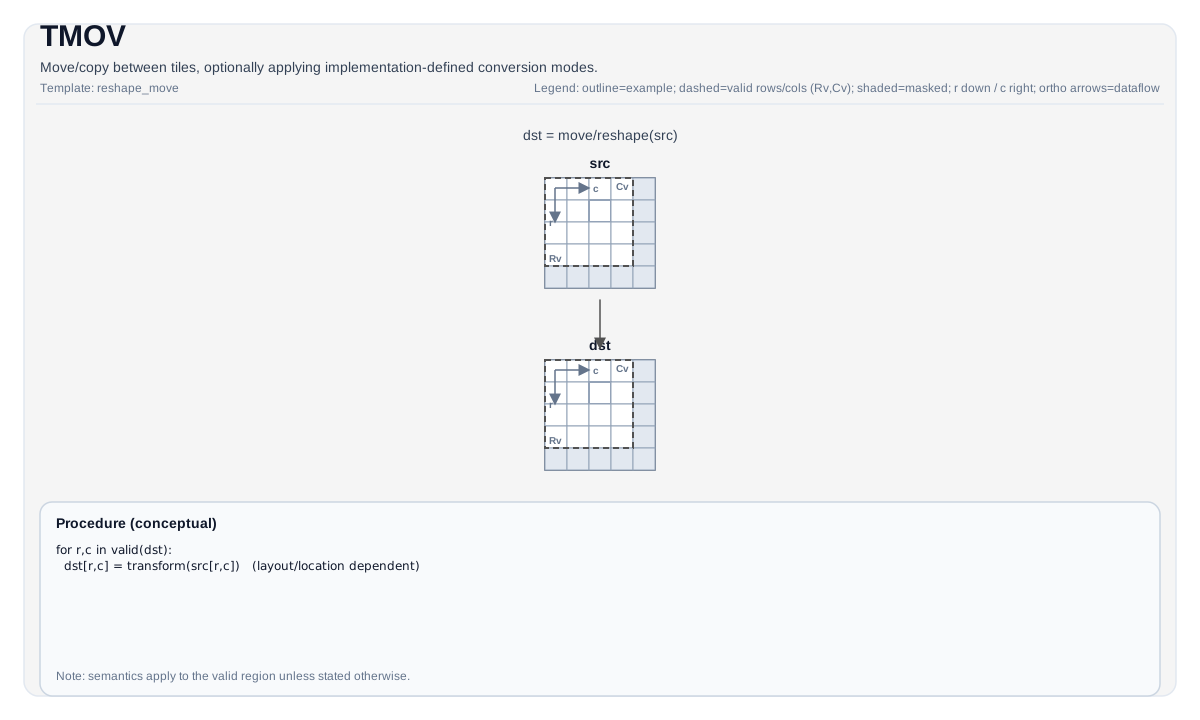
Move/copy between tiles, optionally applying implementation-defined conversion modes selected by template parameters and overloads.
TMOV is used for:
- Vec -> Vec moves
- Mat -> Left/Right/Bias/Scaling/Scale(Microscaling) moves (target-dependent)
- Acc -> Mat/Vec moves (target-dependent)
Math Interpretation
Conceptually copies or transforms elements from src into dst over the valid region. Exact transformation depends on the selected mode and target.
For the pure copy case:
ND → NZ (data repack for the Cube Unit)
The Cube Unit consumes operands in NZ (Normal-ZigZag) fractal format: the tile is
tiled into C0 × C0 fractals, each fractal stored with BLayout = ColMajor (the "N" —
column-major outer blocks) and SLayout = RowMajor (the "Z" — row-major within each
fractal). TMOV(dstNZ, src) repacks a RowMajor Vec/Mat tile (NoneBox) into this
NZ layout. No tmp is required.
| Operand (GM/L1 side) | BLayout |
SLayout |
Meaning |
|---|---|---|---|
| Left (A, NT) | ColMajor |
RowMajor |
normal NZ |
| Right (B, NT) | RowMajor |
ColMajor |
transposed NZ |
A CompactMode::RowPlusOne destination (Rows = Vec_S0 + 1) is the canonical idiom to
avoid UB bank conflicts on the vsstb scatter.
X → ZZ (microscaling exponent repack)
For MXFP8/MXFP4 matmuls the per-group E8M0 exponents must reach the Cube's scale operand
in ZZ format: a [16,2] box (32 B = 16 columns × 2 row-groups), linearised so that
the Cube reads one box per fractal column-pair. Two variants:
ND → ZZ (grp_axis = 1, default): source exponents are ND-grouped (axis-1).
with \(r_b \in [0, R/16)\), \(c \in [0, C/2)\), \(q \in [0,2)\), \(\delta \in [0,16)\).
DN → ZZ (grp_axis = 0): source exponents are DN-grouped (axis-0). Equivalently
transpose then ND→ZZ:
with \(c_b \in [0, N/16)\), \(p \in [0, \hat M/2)\), \(q \in [0,16)\), \(\delta \in \{0,1\}\), \(\hat M = M/32\).
For fixed \((c_b, p)\) the 32 B of the ZZ box come from two contiguous 16-B source runs
(\(E_{DN}[2p]\) and \(E_{DN}[2p+1]\)); DN→ZZ therefore uses contiguous loads + vintlv
(cheaper than ND→ZZ's vgather2).
Role of the tmp tile
Only the X→ZZ transforms take a tmp operand (the 3-arg overload). ND→ZZ uses it as
the vgather2 index buffer; DN→ZZ accepts it for interface parity but does not access it
(the vsstb scatter needs no scratch). ND→NZ has no tmp.
Assembly Syntax
The PTO AS design recommends splitting TMOV into a family of ops:
%left  = tmov.m2l %mat  : !pto.tile<...> -> !pto.tile<...>
%right = tmov.m2r %mat  : !pto.tile<...> -> !pto.tile<...>
%bias  = tmov.m2b %mat  : !pto.tile<...> -> !pto.tile<...>
%scale = tmov.m2s %mat  : !pto.tile<...> -> !pto.tile<...>
%vec   = tmov.a2v %acc  : !pto.tile<...> -> !pto.tile<...>
%v1    = tmov.v2v %v0   : !pto.tile<...> -> !pto.tile<...>
AS Level 1 (SSA)
%dst = pto.tmov.s2d %src : !pto.tile<...> -> !pto.tile<...>
AS Level 2 (DPS)
pto.tmov ins(%src : !pto.tile_buf<...>) outs(%dst : !pto.tile_buf<...>)
C++ Intrinsic
Declared in include/pto/common/pto_instr.hpp and include/pto/common/constants.hpp:
template <typename DstTileData, typename SrcTileData, typename... WaitEvents>
PTO_INST RecordEvent TMOV(DstTileData &dst, SrcTileData &src, WaitEvents &... events);

template <typename DstTileData, typename SrcTileData, ReluPreMode reluMode, typename... WaitEvents>
PTO_INST RecordEvent TMOV(DstTileData &dst, SrcTileData &src, WaitEvents &... events);

template <typename DstTileData, typename SrcTileData, AccToVecMode mode, ReluPreMode reluMode = ReluPreMode::NoRelu,
          typename... WaitEvents>
PTO_INST RecordEvent TMOV(DstTileData &dst, SrcTileData &src, WaitEvents &... events);

template <typename DstTileData, typename SrcTileData, typename FpTileData, AccToVecMode mode,
          ReluPreMode reluMode = ReluPreMode::NoRelu, typename... WaitEvents>
PTO_INST RecordEvent TMOV(DstTileData &dst, SrcTileData &src, FpTileData &fp, WaitEvents &... events);

template <typename DstTileData, typename SrcTileData, ReluPreMode reluMode = ReluPreMode::NoRelu,
          typename... WaitEvents>
PTO_INST RecordEvent TMOV(DstTileData &dst, SrcTileData &src, uint64_t preQuantScalar, WaitEvents &... events);

template <typename DstTileData, typename SrcTileData, AccToVecMode mode, ReluPreMode reluMode = ReluPreMode::NoRelu,
          typename... WaitEvents>
PTO_INST RecordEvent TMOV(DstTileData &dst, SrcTileData &src, uint64_t preQuantScalar, WaitEvents &... events);
ND → NZ / X → ZZ overloads
// ND -> NZ (2-arg, no tmp)
template <typename DstTileData, typename SrcTileData, typename... WaitEvents>
PTO_INST RecordEvent TMOV(DstTileData &dst, SrcTileData &src, WaitEvents &...events);

// X -> ZZ (3-arg, with tmp). grp_axis=1 (default) = ND->ZZ; grp_axis=0 = DN->ZZ.
template <typename DstTileData, typename SrcTileData, typename TmpTileData, typename... WaitEvents,
          std::enable_if_t<is_tile_data_v<TmpTileData>, int> = 0>
PTO_INST RecordEvent TMOV(DstTileData &dst, SrcTileData &src, TmpTileData &tmp, WaitEvents &...events);

template <int grp_axis, typename DstTileData, typename SrcTileData, typename TmpTileData, typename... WaitEvents,
          std::enable_if_t<is_tile_data_v<TmpTileData>, int> = 0>
PTO_INST RecordEvent TMOV(DstTileData &dst, SrcTileData &src, TmpTileData &tmp, WaitEvents &...events);
| Overload | grp_axis |
Transform | tmp used? |
|---|---|---|---|
TMOV(dst, src) |
— | ND → NZ | no |
TMOV(dst, src, tmp) |
1 (default) | ND → ZZ | yes (vgather2 index buffer) |
TMOV<0>(dst, src, tmp) |
0 | DN → ZZ | no (accepted for parity) |
Constraints
General constraints / checks
TMOVhas these overload families:- plain move:
TMOV(dst, src) - relu form:
TMOV<..., reluMode>(dst, src) - accumulator-to-vector form:
TMOV<..., mode, reluMode>(dst, src) - vector-quant form:
TMOV<..., FpTileData, mode, reluMode>(dst, src, fp) - scalar-quant form:
TMOV<..., reluMode>(dst, src, preQuantScalar)andTMOV<..., mode, reluMode>(dst, src, preQuantScalar)
- plain move:
reluModeisReluPreMode::{NoRelu, NormalRelu}.modeisAccToVecMode::{SingleModeVec0, SingleModeVec1, DualModeSplitM, DualModeSplitN}.
A2A3 implementation checks
- Shape must match:
SrcTileData::Rows == DstTileData::RowsandSrcTileData::Cols == DstTileData::Cols. - Supported tile-type pairs are compile-time restricted to:
TileType::Mat -> TileType::Left/Right/Bias/ScalingTileType::Vec -> TileType::VecTileType::Acc -> TileType::Mat
- For
TileType::Mat -> TileType::Bias:- supported source/destination dtype pairs are
int32_t -> int32_t,float -> float, andhalf -> float - source row must be
1 SrcTileData::Cols * sizeof(SrcType)must be aligned to64bytes
- supported source/destination dtype pairs are
- For
TileType::Mat -> TileType::Scaling:- destination dtype must equal source dtype and must be
uint64_torint64_t - source row must be
1 SrcTileData::Cols * sizeof(SrcType)must be aligned to128bytes
- destination dtype must equal source dtype and must be
- For
TileType::Acc -> TileType::Mat:- additional
CheckTMovAccToMat<...>compile-time checks are enforced - plain/relu forms use cast pre-quant mode derived by
GetCastPreQuantMode<SrcDType, DstDType>() - scalar-quant forms use
GetScalarPreQuantMode<SrcDType, DstDType>() - vector-quant forms require an
FpTileDataoperand withFpTileData::Loc == TileType::Scaling, and useGetVectorPreQuantMode<SrcDType, DstDType>() - channel split is not supported
- additional
A5 implementation checks
CommonCheck()requires:- destination/source dtype must be identical
- supported element types are
int8_t,hifloat8_t,float8_e5m2_t,float8_e4m3_t,half,bfloat16_t,float,float4_e2m1x2_t,float4_e1m2x2_t - source layout must satisfy one of:
(SrcTileData::SFractal == SLayout::ColMajor && SrcTileData::isRowMajor)(SrcTileData::SFractal == SLayout::RowMajor && !SrcTileData::isRowMajor)SrcTileData::isRowMajor
CommonCheckMX()for MX paths requires identical source/destination dtype and supportsfloat8_e8m0_t.- Supported paths include:
TileType::Mat -> TileType::Left/Right/Bias/Scaling/ScaleLeft/ScaleRightTileType::Vec -> TileType::Vec/TileType::MatTileType::Acc -> TileType::Vec/TileType::Mat- specific
ND -> ZZand related internal path variants handled by the A5 implementation
- For
TileType::Mat -> TileType::Bias:- supported dtype pairs are
int32_t -> int32_t,float -> float,half -> float,bfloat16_t -> float - source row must be
1 DstTileData::Cols * sizeof(DstType)must be aligned to64bytes- bias-table footprint
DstTileData::Cols * sizeof(DstType)must not exceed4096bytes
- supported dtype pairs are
- For
TileType::Mat -> TileType::Scaling:- source row must be
1 DstTileData::Cols * sizeof(DstType)must be aligned to128bytes- fixpipe-buffer footprint
DstTileData::Cols * sizeof(DstType)must not exceed4096bytes
- source row must be
- For
TileType::Acc -> TileType::Vec:modeselectsSingleModeVec0,SingleModeVec1,DualModeSplitM, orDualModeSplitN- dual-destination modes require
QuantMode_t::NoQuant - dual-destination modes do not support the
nz2dnpath - for 32-bit destination types (
float/int32_t), when usingDualModeSplitNtheValidCol(before the split) must be a multiple of32 - destination stride must be non-zero and
dstStride * sizeof(dstType)must be a multiple of32bytes
- For
TileType::Acc -> TileType::Mat:- destination stride must be non-zero and
dstStride * sizeof(dstType)must be a multiple of32bytes - relu/scalar-quant/vector-quant forms are supported through the corresponding overloads
- destination stride must be non-zero and
Examples
ND → NZ (data) — (128, 256) BF16
// Source: 128 rows × 256 cols BF16 RowMajor Vec tile (ND).
// Destination: NZ fractal Mat tile for the Cube Unit (Left operand).
constexpr uint32_t R = 128, C = 256;
using SrcT = Tile<TileType::Vec, bfloat16_t, R, C, BLayout::RowMajor, R, C, SLayout::NoneBox>;
using DstT = Tile<TileType::Mat, bfloat16_t, R, C, BLayout::ColMajor, R, C, SLayout::RowMajor>;
SrcT src; DstT dst;
TMOV(dst, src);   // ND -> NZ, no tmp
tmp for ND→NZ: none — the 2-arg overload repacks in-place via vsstb.
ND → ZZ (exponents) — tmp size derivation
Given a quantization input of shape \(M \times N\) (group size \(G = 32\)), the ND-grouped E8M0 exponent tile has shape:
| Quantity | Value |
|---|---|
| Exponent rows | \(\mathrm{validRow} = M\) (one exponent row per input row) |
| Exponent cols | \(\mathrm{validCol} = N/G = N/32\) (one exponent per 32-element column group) |
| Row blocks | \(r_b = \lceil M/16 \rceil\) |
| Box-pair count | \(P = \mathrm{validCol}/2 = N/64\) |
The tmp buffer holds the vgather2 B16 index buffer used by GenerateB8IndicesZZToUB:
- 16 B16 lanes of headroom + \(r_b \times P\) gather indices + 16 B16 lanes of tail.
tmpdtype =uint8_t(E8M0), shape1 × ⌈tmpBytes⌉.
Example: \(M = 128\), \(N = 256\) → exponent tile \(128 \times 8\), \(r_b = 8\), \(P = 4\):
DN → ZZ (exponents) — tmp
DN-grouped exponents have shape \(\hat M \times N\) where \(\hat M = M/32\). TMOV<0> accepts
a tmp operand for interface parity with ND→ZZ but does not access it (the vsstb
scatter needs no scratch). Any non-zero-sized tile satisfies the signature.
// DN-grouped e8 exponents (M̂×N) -> ZZ fractal scale tile.
TMOV<0>(e8ZzTile, e8DnTile, tmpTile);   // grp_axis=0 = DN->ZZ; tmp unused
Usage in MX quantization (reference)
After TQUANT produces the quantized data + E8M0 exponents, two TMOVs repack them for
the Cube Unit. See TQUANT.md / TQUANT_DN.md for the full pipeline.
// MXFP8 DN pipeline: quantize a 128×256 BF16 tile, then repack for the Cube.
constexpr uint32_t M = 128, N = 256, G = 32, Mhat = M / G;   // Mhat = 4
// Tiles
using SrcT   = Tile<TileType::Vec, bfloat16_t, M, N, BLayout::RowMajor>;
using Fp8T   = Tile<TileType::Vec, int8_t, M, N, BLayout::RowMajor>;
using E8DnT  = Tile<TileType::Vec, uint8_t, Mhat, N, BLayout::RowMajor>;        // 4×256
using E8ZzT  = Tile<TileType::Mat, uint8_t, N, Mhat, BLayout::ColMajor, N, Mhat, SLayout::RowMajor>;
using Fp8NzT = Tile<TileType::Mat, int8_t, M, N, BLayout::ColMajor, M, N, SLayout::RowMajor>;
// 1. Quantize (DN grouping)
TQUANT<0, MxQuantAlg::OcpMxFp8E4M3>(fp8Tile, srcTile, &e8DnTile, &maxTile, &scalingTile);
// 2. Repack data ND->NZ (2-arg, no tmp)
TMOV(fp8NzTile, fp8Tile);
// 3. Repack exponents DN->ZZ (3-arg, tmp accepted but unused)
TMOV<0>(e8ZzTile, e8DnTile, tmpTile);
Auto
#include <pto/pto-inst.hpp>

using namespace pto;

void example_auto() {
  using TileT = Tile<TileType::Vec, float, 16, 16>;
  TileT src, dst;
  TMOV(dst, src);
}
Manual
#include <pto/pto-inst.hpp>

using namespace pto;

void example_manual() {
  using SrcT = Tile<TileType::Mat, float, 16, 16, BLayout::RowMajor, 16, 16, SLayout::ColMajor>;
  using DstT = TileLeft<float, 16, 16>;
  SrcT mat;
  DstT left;
  TASSIGN(mat, 0x1000);
  TASSIGN(left, 0x2000);
  TMOV(left, mat);
}
ASM Form Examples
Auto Mode
# Auto mode: compiler/runtime-managed placement and scheduling.
%dst = pto.tmov.s2d %src  : !pto.tile<...> -> !pto.tile<...>
Manual Mode
# Manual mode: resources must be bound explicitly before issuing the instruction.
# Optional for tile operands:
# pto.tassign %arg0, @tile(0x1000)
# pto.tassign %arg1, @tile(0x2000)
%dst = pto.tmov.s2d %src  : !pto.tile<...> -> !pto.tile<...>
PTO Assembly Form
%dst = pto.tmov.s2d %src  : !pto.tile<...> -> !pto.tile<...>
# AS Level 2 (DPS)
pto.tmov ins(%src : !pto.tile_buf<...>) outs(%dst : !pto.tile_buf<...>)