TXOR
Tile Operation Diagram
Introduction
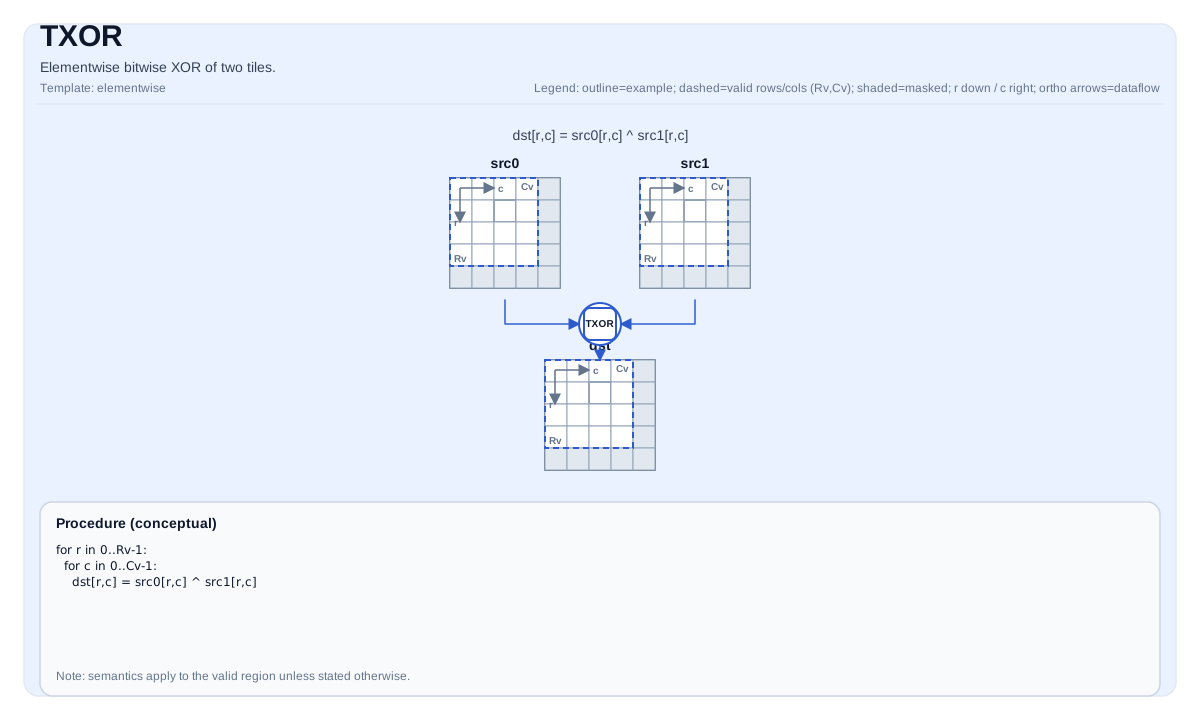
Elementwise bitwise XOR of two tiles.
Math Interpretation
For each element (i, j) in the valid region:
\[ \mathrm{dst}_{i,j} = \mathrm{src0}_{i,j} \oplus \mathrm{src1}_{i,j} \]
Assembly Syntax
Synchronous form:
%dst = txor %src0, %src1 : !pto.tile<...>
AS Level 1 (SSA)
%dst = pto.txor %src0, %src1 : (!pto.tile<...>, !pto.tile<...>) -> !pto.tile<...>
AS Level 2 (DPS)
pto.txor ins(%src0, %src1 : !pto.tile_buf<...>, !pto.tile_buf<...>) outs(%dst : !pto.tile_buf<...>)
C++ Intrinsic
Declared in include/pto/common/pto_instr.hpp:
template <typename TileDataDst, typename TileDataSrc0, typename TileDataSrc1, typename TileDataTmp,
          typename... WaitEvents>
PTO_INST RecordEvent TXOR(TileDataDst &dst, TileDataSrc0 &src0, TileDataSrc1 &src1, TileDataTmp &tmp, WaitEvents &... events);
Constraints
- The op iterates over
dst.GetValidRow()/dst.GetValidCol(). - Implementation checks (A5):
dst,src0, andsrc1element types must match.- Supported element types are
uint8_t,int8_t,uint16_t,int16_t,uint32_t,int32_t. dst,src0, andsrc1must be row-major.src0.GetValidRow()/GetValidCol()andsrc1.GetValidRow()/GetValidCol()must matchdst.
- Implementation checks (A2A3):
dst,src0,src1, andtmpelement types must match.- Supported element types are
uint8_t,int8_t,uint16_t,int16_t,uint32_t,int32_t. dst,src0,src1, andtmpmust be row-major.src0,src1, andtmpvalid shapes must matchdst.- In manual mode,
dst,src0,src1, andtmpmust not overlap in memory.
Temporary Space
A2A3
tmp is used as intermediate scratch storage. The A2A3 implementation computes XOR via decomposition: XOR(a,b) = AND(NOT(AND(a,b)), OR(a,b)), which requires tmp to hold the intermediate OR(a,b) result.
tmpmust have the same element type asdst/src0/src1.tmpmust be row-major.tmp.GetValidRow() >= dst.GetValidRow()andtmp.GetValidCol() >= dst.GetValidCol().- In manual mode,
tmpmust not overlap in memory withdst,src0, orsrc1.
A5
tmp is accepted by the interface but not used by the A5 implementation. The A5 backend uses the vxor vector instruction directly and does not require scratch tile storage. tmp is retained in the C++ intrinsic signature solely for API compatibility with A2A3.
Examples
#include <pto/pto-inst.hpp>

using namespace pto;

void example() {
  using TileDst = Tile<TileType::Vec, uint32_t, 16, 16>;
  using TileSrc0 = Tile<TileType::Vec, uint32_t, 16, 16>;
  using TileSrc1 = Tile<TileType::Vec, uint32_t, 16, 16>;
  using TileTmp = Tile<TileType::Vec, uint32_t, 16, 16>;
  TileDst dst;
  TileSrc0 src0;
  TileSrc1 src1;
  TileTmp tmp;
  TXOR(dst, src0, src1, tmp);
}
ASM Form Examples
Auto Mode
# Auto mode: compiler/runtime-managed placement and scheduling.
%dst = pto.txor %src0, %src1 : (!pto.tile<...>, !pto.tile<...>) -> !pto.tile<...>
Manual Mode
# Manual mode: resources must be bound explicitly before issuing the instruction.
# Optional for tile operands:
# pto.tassign %arg0, @tile(0x1000)
# pto.tassign %arg1, @tile(0x2000)
%dst = pto.txor %src0, %src1 : (!pto.tile<...>, !pto.tile<...>) -> !pto.tile<...>
PTO Assembly Form
%dst = txor %src0, %src1 : !pto.tile<...>
# AS Level 2 (DPS)
pto.txor ins(%src0, %src1 : !pto.tile_buf<...>, !pto.tile_buf<...>) outs(%dst : !pto.tile_buf<...>)