TROWEXPANDSUB
Tile Operation Diagram
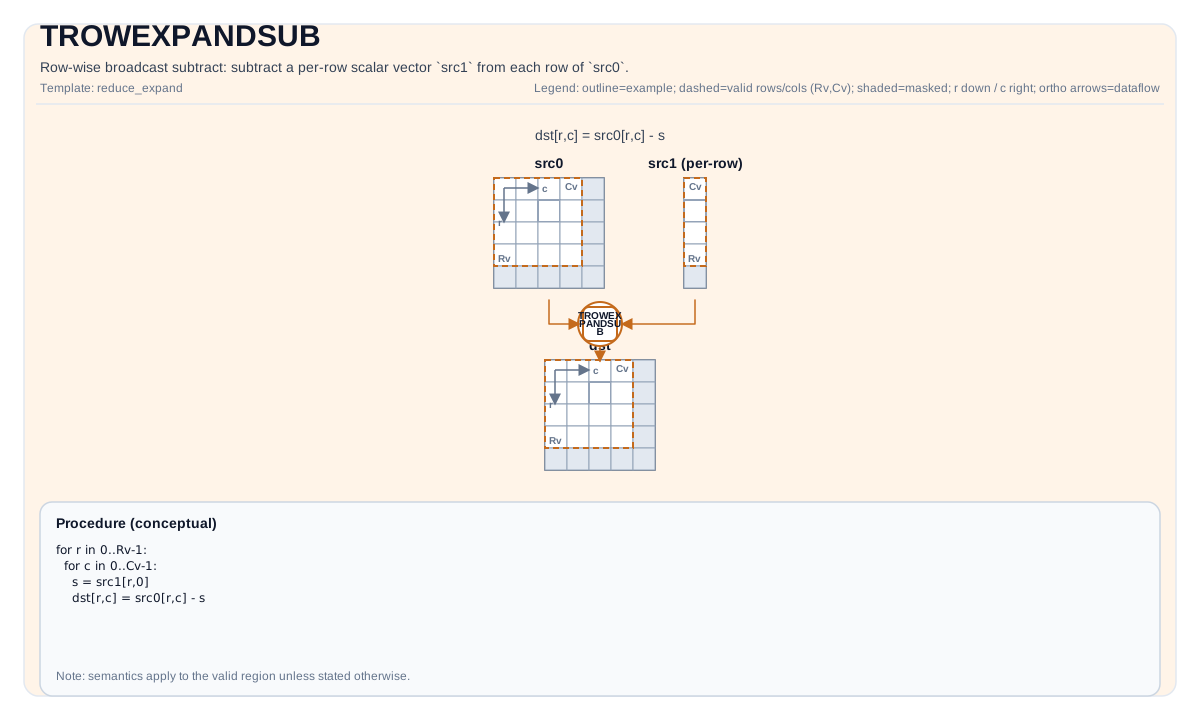
Mode 1 — Scalar per row (ColMajor src1)
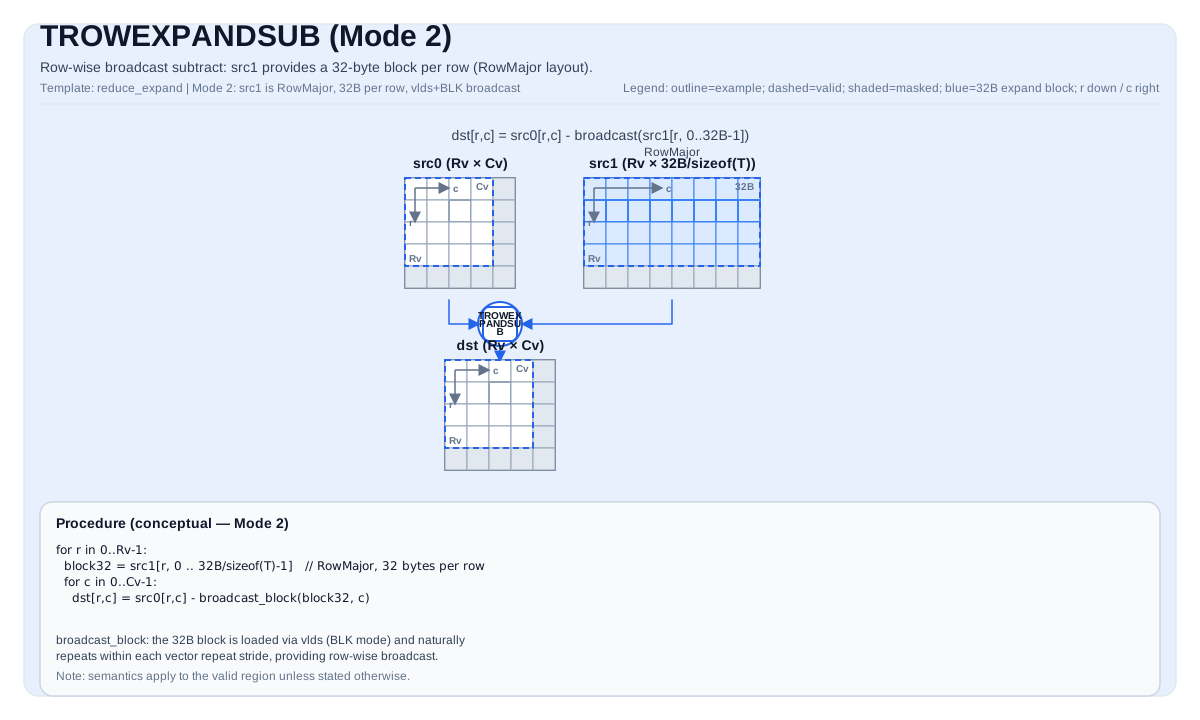
Mode 2 — 32-byte block per row (RowMajor src1)
Introduction
Row-wise broadcast subtract: subtract a per-row broadcast operand from each row of src0.
The instruction supports two modes determined by the layout of the expanded operand (src1 when src0 matches dst shape, or src0 when src1 matches dst shape):
- Mode 1: The expanded operand is ColMajor with a single column (one scalar per row). Each scalar is broadcast across the entire row.
- Mode 2: The expanded operand is RowMajor with
32 / sizeof(T)columns per row (a 32-byte block per row).
Math Interpretation
Let R = dst.GetValidRow() and C = dst.GetValidCol().
Mode 1
Let s_i be the per-row scalar taken from the expanded operand (one value per row, ColMajor layout).
For 0 <= i < R and 0 <= j < C:
Mode 2
Let b_i be the 32-byte block for row i taken from the expanded operand (RowMajor, 32 / sizeof(T) values per row). The block naturally repeats every elementsPerRepeat elements within a row.
For 0 <= i < R and 0 <= j < C:
Assembly Syntax
Synchronous form:
%dst = trowexpandsub %src0, %src1 : !pto.tile<...>, !pto.tile<...> -> !pto.tile<...>
AS Level 1 (SSA)
%dst = pto.trowexpandsub %src0, %src1 : !pto.tile<...>, !pto.tile<...> -> !pto.tile<...>
AS Level 2 (DPS)
pto.trowexpandsub ins(%src0, %src1 : !pto.tile_buf<...>, !pto.tile_buf<...>) outs(%dst : !pto.tile_buf<...>)
C++ Intrinsic
Declared in include/pto/common/pto_instr.hpp:
template <typename TileDataDst, typename TileDataSrc0, typename TileDataSrc1, typename... WaitEvents>
PTO_INST RecordEvent TROWEXPANDSUB(TileDataDst &dst, TileDataSrc0 &src0, TileDataSrc1 &src1, WaitEvents &... events);

template <typename TileDataDst, typename TileDataSrc0, typename TileDataSrc1, typename TileDataTmp,
          typename... WaitEvents>
PTO_INST RecordEvent TROWEXPANDSUB(TileDataDst &dst, TileDataSrc0 &src0, TileDataSrc1 &src1, TileDataTmp &tmp, WaitEvents &... events);
Constraints
TileDataDst::DType == TileDataSrc0::DType == TileDataSrc1::DTypeTileDataDst::DType,TileDataSrc0::DType,TileDataSrc1::DTypemust be one of:half,float,int16,int32for A2, A3 and A5,uint16,uint32,bfloat16_t,int8,uint8for A5.TileDataDstmust be RowMajor (TileDataDst::isRowMajor == true).- Exactly one of
src0orsrc1must have the same valid shape asdst(i.e.,validRow == dst.validRowandvalidCol == dst.validCol). That operand is the full-sized operand. The other operand is the expanded operand (row-broadcast source). - The full-sized operand must be RowMajor (
isRowMajor == true).
Mode 1 — Expanded operand is ColMajor (scalar per row)
When the expanded operand is ColMajor (isRowMajor == false):
- Its valid column count must be 1 (one scalar per row):
srcX.GetValidCol() == 1. - Its valid row count must equal
dst.GetValidRow():srcX.GetValidRow() == dst.GetValidRow().
Mode 2 — Expanded operand is RowMajor (32-byte block per row)
When the expanded operand is RowMajor (isRowMajor == true):
- Its valid column count must be 32 / sizeof(T) (a 32-byte block per row):
srcX.GetValidCol() == 32 / sizeof(T). - For
half/int16/uint16:validCol == 16. - For
float/int32/uint32:validCol == 8. - Its valid row count must equal
dst.GetValidRow():srcX.GetValidRow() == dst.GetValidRow().
Additional target-specific constraints
Exact layout, fractal, and alignment constraints may vary by backend target. See backend headers under include/pto/npu/*/TRowExpand*.hpp.
Temporary tile
The C++ API provides an overload with an explicit TileDataTmp &tmp. This overload only supports Mode 1 (ColMajor expanded operand, scalar per row).
- A2A3: The tmp tile is used as a broadcast buffer. The per-row scalar values from the ColMajor expanded operand are broadcast via the
vbrcbinstruction into the tmp buffer, creating a 32-byte block per row, which is then used as the expanded operand in the binary operation. Thevbrcbinstruction uses a repeat stride of 8 blocks (256 bytes) between repeat groups, processing 8 rows per repeat. Minimum tmp size calculation:- Common parameters:
R = dst.GetValidRow(),T = TileDataDst::DType.
- For
R < 256: $$ \text{tmpSize} = \left\lceil\frac{R}{8}\right\rceil \times 256 \text{ bytes} $$ - For
R >= 256:- The operation is looped, with at most 30 repeats (240 rows) per loop iteration. The tmp buffer is reused across loops, so the per-loop requirement is: $$ \text{tmpSize} = 30 \times 256 = 7680 \text{ bytes} $$
- A compact shape-independent upper bound for any Mode 1 invocation is 8KB (8192 bytes).
- The 3-arg overload (without
tmp) supports both Mode 1 and Mode 2. For Mode 1, it uses an internal 8KB buffer (TMP_UB_OFFSET). For Mode 2, no broadcast buffer is needed.
- Common parameters:
- A5: The
tmptile is accepted and ignored ([[maybe_unused]]). A5 hardware supports row-broadcast natively via thevldsinstruction's broadcast modes, so no scratch buffer is required.
Examples
Auto
#include <pto/pto-inst.hpp>

using namespace pto;

void example_auto() {
  using TileT = Tile<TileType::Vec, half, 16, 16>;
  using RowVecT = Tile<TileType::Vec, half, 16, 1, BLayout::ColMajor, 1, DYNAMIC, SLayout::NoneBox>;

  TileT src0, dst;
  RowVecT src1(16);
  TROWEXPANDSUB(dst, src0, src1);
}
Manual
#include <pto/pto-inst.hpp>

using namespace pto;

void example_manual() {
  using TileT = Tile<TileType::Vec, half, 16, 16>;
  using RowVecT = Tile<TileType::Vec, half, 16, 1, BLayout::ColMajor, 1, DYNAMIC, SLayout::NoneBox>;

  TileT src0, dst;
  RowVecT src1(16);
  TASSIGN(src0, 0x1000);
  TASSIGN(dst,  0x2000);
  TASSIGN(src1, 0x3000);
  TROWEXPANDSUB(dst, src0, src1);
}
ASM Form Examples
Auto Mode
# Auto mode: compiler/runtime-managed placement and scheduling.
%dst = pto.trowexpandsub %src0, %src1 : !pto.tile<...>, !pto.tile<...> -> !pto.tile<...>
Manual Mode
# Manual mode: resources must be bound explicitly before issuing the instruction.
# Optional for tile operands:
# pto.tassign %arg0, @tile(0x1000)
# pto.tassign %arg1, @tile(0x2000)
%dst = pto.trowexpandsub %src0, %src1 : !pto.tile<...>, !pto.tile<...> -> !pto.tile<...>
PTO Assembly Form
%dst = trowexpandsub %src0, %src1 : !pto.tile<...>, !pto.tile<...> -> !pto.tile<...>
# AS Level 2 (DPS)
pto.trowexpandsub ins(%src0, %src1 : !pto.tile_buf<...>, !pto.tile_buf<...>) outs(%dst : !pto.tile_buf<...>)