MSCATTER
Tile Operation Diagram
Introduction
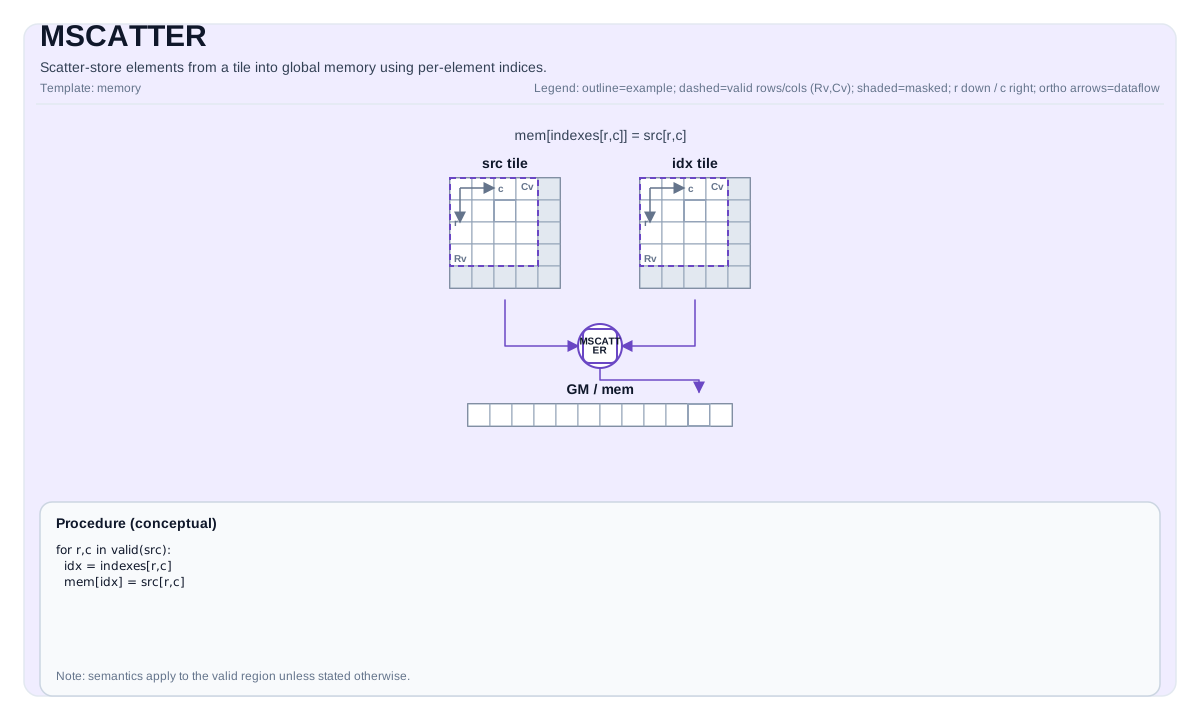
MSCATTER writes data from a UB source tile into a GM GlobalTensor through a UB index tile. The operating mode is selected explicitly through the Coalesce template parameter:
Coalesce::Row(default) — scatter full rowssrc[r, :]intotable[idx[r], :]. The index tile is 1-D ([1, R]row-major; on A5 also[R, 1]column-major).R = 1is allowed.Coalesce::Elem— element-wise scatter fromsrc[R, C](orsrc[1, N]) into a linearizedtablethroughidx[R, C]. The index tile must have the same valid shape as the source. The degenerate(1, 1)case is allowed.
Write behaviour is controlled by orthogonal template policies:
ScatterAtomicOp—None(plain store),Add,Max,Min. Atomic dtype support varies per target (see the table below).ScatterOOB—Undefined,Skip,Clamp,Wrap. There is noZerooption (the operation writes into an existing table; out-of-bounds indices have no real destination to zero).ScatterConflict(A5 only) —Last(deterministic largest-index wins, only consulted whenAtomic == None) orDefault(warp-scheduler dependent). A2/A3 has noScatterConflictparameter because the kernel is strictly sequential and collisions are resolved by "last write wins".
Per-target dispatch summary:
- CPU Simulator — pure C++ reference. The implementation walks
validRow * validColwith a plain sequentialforloop in row-major order and writestable[idx[i, j]] = src[i, j](Elem semantics). When multiple sources map to the same destination, the last writer in row-major iteration order wins. - A2/A3 VEC-CORE — single-threaded scalar / MTE3 walk driven from the scalar pipe. Row mode issues one wide
copy_ubuf_to_gm_align_b*DMA per row throughtablePtr + safeIdx * tableRowStride(wheretableRowStride = table.GetStride(DIM_3)andtableRows = ∏ Shape[0..3]); Elem mode performs a scalar UB→GM store per element (DMA bursts cannot satisfy per-element UB-source 32-byte alignment). Supports ND-GM with ND-UB and NZ-GM with NZ-UB tile pairs. Always "last write wins" forScatterAtomicOp::None. - A5 SIMT — SIMT launch through
cce::async_invokewith up todim3{32, 32}(1024 threads). Row mode uses warp-parallel lane writes that the SIMT hardware coalesces into 128 B GM bursts when consecutive; Elem mode maps one lane to one element with per-lane scalar GM stores. The Row kernel computesdstRow = table + safeIdx * validCols, so the GM table is treated as packed ND with row stride =validCols—MScatterCheckenforcesGlobalTable::staticShape[4] == TileSrc::ValidColat compile time, andtableRows = Shape[3].Conflict::Lastis implemented as a slot-centric reverse scan (last_owner_find_*) so the result is deterministic and race-free. NZ block-stride layouts are not implemented on A5. The(1, 1)Elem case bypasses the SIMT launch and runsMScatterScalarImplon the AIV vector core.
Math Interpretation
Row Coalesce (Coalesce::Row)
Source src[R, C], index idx[1, R] (or idx[R, 1] on A5), table table[TableRows, C]. For each row r:
where atom is the identity (replace) for ScatterAtomicOp::None or the corresponding atomic accumulation otherwise.
Element Coalesce (Coalesce::Elem)
Source src[R, C], index idx[R, C] (same valid shape as src), flat table of length TableSize:
TableSize = Shape[0] * Shape[1] * Shape[2] * Shape[3] * Shape[4] of the destination GlobalTensor. For NZ tables (A2/A3) the scalar idx is decomposed into (logicalRow, logicalCol) and then translated to the NZ block-stride GM offset through MScatterNZGmOffset.
Atomic Accumulation
When ScatterAtomicOp::Add / Max / Min is selected:
Conflict Resolution
- A2/A3. The kernel is strictly sequential in increasing
(r)(Row) or(r, c)(Elem) order. ForScatterAtomicOp::None, the later write always wins ("last write wins"). ForScatterAtomicOp::Addevery Row-mode store goes through the MTE3 atomic-add unit and every Elem-mode store does a scalar read-add-write; duplicate destination indices accumulate. - A5. With
ScatterAtomicOp::None:Conflict::Last— the source position with the largest flat index that targets a given destination slot is the one whose value is stored. Matches the sequential semantics offor i in 0..N: table[idx[i]] = src[i]. Implemented as a slot-centric reverse scan (per-warplast_owner_find_*), race-free by construction.Conflict::Default— the surviving writer is warp-scheduler dependent. For collision-free index sets the result is identical toLast.
- CPU simulator. Last writer in row-major iteration order wins (matches
Conflict::Last).
Atomic modes ignore ScatterConflict because the GM atomic R-M-W serialises colliding writes by itself.
Out-of-Bounds Behaviour
enum class ScatterOOB : uint8_t {
    Undefined = 0,  // No bounds check; caller guarantees valid indices
    Skip      = 1,  // Drop the write (preserve original table value)
    Clamp     = 2,  // Clamp index to capacity - 1
    Wrap      = 3   // Index modulo capacity
};
capacity is TableRows (Row mode) or TableSize (Elem mode):
Undefined: caller guaranteesidx < capacity; no remap is applied.Skip: out-of-bounds rows / elements are simply not written (no DMA issued, no scalar store performed). The original table value at that GM address is preserved.Clamp:idx = min(idx, capacity - 1)before access.Wrap:idx = idx % capacitybefore access.
There is no Zero option — an OOB index never identifies a real destination slot, so Skip is the natural "do nothing on OOB" policy.
Assembly Syntax
Synchronous form:
mscatter %src, %mem, %idx : !pto.memref<...>, !pto.tile<...>, !pto.tile<...>
Row coalesce:
mscatter.row %table, %src, %idx : (!pto.memref<...>, !pto.tile<RxCxT>, !pto.tile<1xRxi32>)
Element coalesce:
mscatter.elem %table, %src, %idx : (!pto.memref<...>, !pto.tile<RxCxT>, !pto.tile<RxCxi32>)
OOB and atomic variants append the mode suffix (mscatter.row.clamp.atomic_add, mscatter.elem.skip, etc.).
AS Level 1 (SSA)
pto.mscatter %src, %idx, %mem : (!pto.tile<...>, !pto.tile<...>, !pto.partition_tensor_view<MxNxdtype>) -> ()
AS Level 2 (DPS)
pto.mscatter ins(%src, %idx : !pto.tile_buf<...>, !pto.tile_buf<...>) outs(%mem : !pto.partition_tensor_view<MxNxdtype>)
C++ Intrinsic
Declared in include/pto/common/pto_instr.hpp (the shared dispatcher) and the per-target implementation headers (include/pto/cpu/MScatter.hpp, include/pto/npu/a2a3/MScatter.hpp, include/pto/npu/a5/MScatter.hpp).
CPU Reference Form
template <typename GlobalData, typename TileSrc, typename TileInd, typename... WaitEvents>
PTO_INST RecordEvent MSCATTER(GlobalData &dst, TileSrc &src, TileInd &indexes, WaitEvents &... events);
A2/A3 Form
template <Coalesce        CMode  = Coalesce::Row,
          ScatterAtomicOp AtomOp = ScatterAtomicOp::None,
          ScatterOOB      Oob    = ScatterOOB::Undefined,
          typename GlobalTable, typename TileSrc, typename TileIdx,
          typename... WaitEvents>
PTO_INST RecordEvent MSCATTER(GlobalTable& table, TileSrc& src, TileIdx& idx,
                              WaitEvents&... events);
A2/A3 has no ScatterConflict template parameter (the kernel is always sequential, so collisions are deterministic "last write wins"). Dispatched as a regular AIV function call — no async-launch or cross-core orchestration.
A5 Form
template <Coalesce         Mode     = Coalesce::Row,
          ScatterAtomicOp  Atomic   = ScatterAtomicOp::None,
          ScatterOOB       Oob      = ScatterOOB::Undefined,
          ScatterConflict  Conflict = ScatterConflict::Last,
          typename GlobalTable, typename TileSrc, typename TileIdx,
          typename... WaitEvents>
PTO_INST RecordEvent MSCATTER(GlobalTable& table, TileSrc& src, TileIdx& idx,
                              WaitEvents&... events);
The implementation launches one of simt_mscatter_row_kernel, simt_mscatter_row_last_kernel, simt_mscatter_elem_kernel, or simt_mscatter_elem_last_kernel through cce::async_invoke<…>(cce::dim3{32, kLaunchWarps}, …). UB addressing inside the SIMT kernel goes through tile_offset_2d<TileX>(r, c), which makes the kernel layout-agnostic for UB tiles. The degenerate Elem (1, 1) case bypasses the SIMT launch and runs MScatterScalarImpl on the AIV vector core.
Parameters (NPU forms)
table— destination GMGlobalTensor.GlobalTensor::DTypemust be__gm__ Tmatching the source element type.src— UB source tile (TileType::Vec); shape[R, C].idx— UB index tile (TileType::Vec).CMode/Mode—Coalescevalue (RoworElem). First template parameter, so the operating mode is always explicit at the call site.AtomOp/Atomic—ScatterAtomicOpvalue.Max/Minare not supported on A2/A3.Oob—ScatterOOBvalue for out-of-bounds handling.Conflict(A5 only) —ScatterConflictvalue. Consulted only whenAtomic == None.
Enums
enum class Coalesce : uint8_t {
    Row  = 0,  // table[idx[r], :] = src[r, :]   (1-D index of length R)
    Elem = 1   // table[idx[i, j]] = src[i, j]   (idx shape == src shape)
};

enum class ScatterAtomicOp : uint8_t {
    None = 0,  // Plain store (collision-resolved by ScatterConflict on A5)
    Add  = 1,  // Atomic addition
    Max  = 2,  // Atomic maximum (A5 only)
    Min  = 3   // Atomic minimum (A5 only)
};

enum class ScatterOOB : uint8_t {
    Undefined = 0,
    Skip      = 1,
    Clamp     = 2,
    Wrap      = 3
};

enum class ScatterConflict : uint8_t {  // A5 only
    Last    = 0,  // Deterministic: largest source index wins
    Default = 1   // Warp-scheduler dependent
};
Atomic Type Support
| Atomic | CPU (ABI contract / simulator behavior) | A2/A3 | A5 |
|---|---|---|---|
None |
all dtypes | all dtypes | all dtypes |
Add |
ABI contract: int32_t, uint32_t, float, half (simulator ignores the template parameter and runs plain replace with last-writer-wins) |
int8_t, int16_t, int32_t, half, bfloat16_t, float (signed integers only — no uint*; MTE3 atomic-add unit in Row, scalar read-modify-write in Elem) |
int32_t, uint32_t, float, half, bfloat16_t (SIMT atomicAdd) |
Max |
ABI contract: int32_t or float (simulator runs plain replace) |
unsupported (rejected at compile time by MScatterCheck) |
int32_t, uint32_t, float (SIMT atomicMax) |
Min |
ABI contract: int32_t or float (simulator runs plain replace) |
unsupported (rejected at compile time by MScatterCheck) |
int32_t, uint32_t, float (SIMT atomicMin) |
A2/A3 Max / Min would need a hardware atomic-max/min unit on the MTE3 path that the SoC does not provide; MScatterCheck static-asserts reject them.
Constraints
The constraints below are split into target-specific sections so each backend lists exactly what its implementation enforces. Symbols that are common across targets (T = TileSrc::DType, TIdx = TileIdx::DType) are reused.
Tile Constraints (CPU)
Supported data types:
src/dstelement type must be one of:int8_t,uint8_t,int16_t,uint16_t,int32_t,uint32_t,half,bfloat16_t,float.- On AICore targets (CPU simulator compiled with
__CCE_AICORE__),float8_e4m3_tandfloat8_e5m2_tare also supported. indexeselement type must beint32_toruint32_t.
Tile and memory types:
srcmust be a vector tile (TileType::Vec).indexesmust be a vector tile (TileType::Vec).srcandindexesmust use row-major layout (BLayout::RowMajor + SLayout::NoneBox).dstmust be aGlobalTensorin GM memory.dstmust useLayout::ND.
Atomic operation constraints:
- Non-atomic scatter is supported for all supported element types.
ScatterAtomicOp::Addmode requiresint32_t,uint32_t,float, orhalf.ScatterAtomicOp::Max/Minmode requiresint32_torfloat.
Shape constraints:
src.Rows == indexes.Rows(the index tile and source tile share the row count).indexesmust be shaped as[N, 1]for row-indexed scatter or[N, M]for element-indexed scatter.srcrow width must be 32-byte aligned, that is,src.Cols * sizeof(TileSrc::DType)must be a multiple of 32.dststatic shape must satisfyShape<1, 1, 1, TableRows, RowWidth>.
Index interpretation:
- Index interpretation is target-defined. The CPU simulator treats indices as linear element indices into
dst.data()and writesdst.data()[idx] = src.data()[srcOff]for every(r, c)in the source valid region — equivalent toCoalesce::Elemsemantics, regardless of the index tile shape. - The simulator does not model
ScatterConflicttemplate parameters; the implementation always uses "last writer in row-major iteration order wins" as the conflict policy.
Header-level enforcement. The CPU header (include/pto/cpu/MScatter.hpp) static-asserts only the minimum closure rules: std::is_integral_v<TileInd::DType> for the index dtype and sizeof(TileSrc::DType) == sizeof(GlobalData::DType) for byte-wise compatibility. The dtype / shape / atomic / layout constraints above are the PTO ABI contract — callers are expected to honor them so the same kernel source compiles and runs unmodified against the A2/A3 and A5 backends.
Tile Constraints (A2/A3)
Supported data types:
src/dstelement type must be one of:int8_t,uint8_t,int16_t,uint16_t,int32_t,uint32_t,half,bfloat16_t,float. Nofloat8_e4m3_t/float8_e5m2_t/hifloat8_ton the A2/A3 vec-core.indexeselement type must beint32_toruint32_t.
Tile and memory types:
srcmust be a vector tile (TileSrc::Loc == TileType::Vec).indexesmust be a vector tile (TileIdx::Loc == TileType::Vec).- The index tile is always
BLayout::RowMajor + SLayout::NoneBox(ND), regardless of the table layout. dstmust be aGlobalTensorin GM memory;GlobalTable::DType == __gm__ T.- The source tile's bulk + sub layout must be paired with the table layout exactly:
GlobalTable::layout == Layout::ND⇒TileSrcisBLayout::RowMajor + SLayout::NoneBox.GlobalTable::layout == Layout::NZ⇒TileSrcisBLayout::ColMajor + SLayout::RowMajor + SFractalSize == TileConfig::fractalABSize(= 512 B).
Atomic operation constraints:
ScatterAtomicOp::Noneis supported for all of the dtypes above.ScatterAtomicOp::Addrequiresint8_t,int16_t,int32_t,half,bfloat16_t, orfloat. Unsigned-integer atomic-add is not supported on A2/A3 (nouint8_t/uint16_t/uint32_t).ScatterAtomicOp::MaxandMinare not supported on A2/A3 —MScatterCheckrejects them at compile time.
Shape constraints:
- Padded
TileSrc::Cols * sizeof(T)must be 32-byte aligned in both layouts (the same DMA-burst rule thatTLOAD/TSTOREenforce).ValidRow/ValidColare not constrained by this rule. - For
Coalesce::Row:TileIdx::ValidRow == 1andTileIdx::ValidCol == TileSrc::ValidRow. - For
Coalesce::Elem:TileIdx::ValidRow == TileSrc::ValidRowandTileIdx::ValidCol == TileSrc::ValidCol. - Both modes require
TileSrc::ValidRow >= 1andTileSrc::ValidCol >= 1. - NZ tables additionally require
GlobalTable::staticShape[3] == FRACTAL_NZ_ROW(= 16),GlobalTable::staticShape[4] == C0_SIZE_BYTE / sizeof(T)(= 32 B / element width),TileSrc::Cols % (C0_SIZE_BYTE / sizeof(T)) == 0, andTileSrc::Rows % FRACTAL_NZ_ROW == 0.
Index interpretation:
- For
Coalesce::Row, each index is treated as a logical row index into the[TableRows, RowWidth]ND table (or as a logical row acrossgShape2 * FRACTAL_NZ_ROWfor NZ). - For
Coalesce::Elem, each index is treated as a linear element index into the flat 5-D table (tableSize = ∏ shape[0..4]). For NZ the kernel splits the linear index into(logicalRow = idx / nLogicalCols, logicalCol = idx % nLogicalCols)and applies the NZ block-stride translation. - OOB handling follows the
ScatterOOBtemplate parameter (Undefined/Skip/Clamp/Wrap); see the Out-of-Bounds subsection above.
Tile Constraints (A5)
Supported data types:
src/dstelement type must be one of:int8_t,uint8_t,int16_t,uint16_t,int32_t,uint32_t,half,bfloat16_t,float. On__CCE_AICORE__builds the list also includeshifloat8_t,float8_e4m3_t,float8_e5m2_t.indexeselement type must beint32_toruint32_t.
Tile and memory types:
srcmust be a vector tile (TileSrc::Loc == TileType::Vec).indexesmust be a vector tile (TileIdx::Loc == TileType::Vec).- The SIMT kernel is layout-agnostic for UB tiles: every UB read/write goes through
tile_offset_2d<TileX>(r, c), soTileSrcmay beBLayout::RowMajororBLayout::ColMajor(withSLayout::NoneBox). dstmust be aGlobalTensorin GM memory;GlobalTable::DType == __gm__ T.- GM table layout:
Layout::NDonly. A5 SIMT kernels address GM as a flat row-major buffer with row stride hard-wired tovalidCols(dstRow = table + safeIdx * validCols);MScatterCheckenforcesGlobalTable::staticShape[4] == TileSrc::ValidColso the table cannot have any inter-row padding. The kernel does not honor any otherGlobalTensor::layoutvalue —MScatterCheckdoes not static-assert the GMlayoutfield, but usingLayout::NZ(or anything other than packed ND with row width =validCols) produces wrong output because the kernel never performs block-stride translation. Callers that need NZ data must pre-stage into ND.
Atomic operation constraints:
ScatterAtomicOp::Noneis supported for all of the dtypes above.ScatterAtomicOp::Addrequiresint32_t,uint32_t,float,half, orbfloat16_t(uses SIMTatomicAdd).ScatterAtomicOp::Maxrequiresint32_t,uint32_t, orfloat(uses SIMTatomicMax).ScatterAtomicOp::Minrequiresint32_t,uint32_t, orfloat(uses SIMTatomicMin).IsValidScatterAtomic<T, Atomic>::valuerejects unsupported combinations at compile time.
Shape constraints:
- Padded
TileSrc::Cols * sizeof(T)(RowMajor) orTileSrc::Rows * sizeof(T)(ColMajor) must be 32-byte aligned — this is an upstreamTLOAD/TSTORErequirement, not aMSCATTERconstraint per se.ValidRow/ValidColare not constrained by this rule. - For
Coalesce::Row: the index tile's valid shape is[1, R](BLayout::RowMajor) or[R, 1](BLayout::ColMajor). Both forms produce a linear R-element layout in UB and the kernel readsidx[row]directly. The choice ofBLayoutfor the index tile is independent of the GM table layout —MScatterCheckdoes not constrain the GMlayoutfield for the table. - For
Coalesce::Elem:TileIdx::ValidRow == TileSrc::ValidRowandTileIdx::ValidCol == TileSrc::ValidCol. TheBLayoutofTileIdxis independent ofTileSrc's — the kernel walks both through per-tiletile_offset_2d. - Both modes require
TileSrc::ValidRow >= 1andTileSrc::ValidCol >= 1. The degenerate(1, 1)shape in Elem mode bypasses the SIMT launch and runsMScatterScalarImplon the AIV vector core.
Index interpretation:
- For
Coalesce::Row, each index is treated as a logical row index into the[TableRows, validCols]ND table; the kernel computesdstRow = table + safeIdx * validCols. - For
Coalesce::Elem, each index is treated as a linear element index into the flat 5-D table (tableSize = ∏ shape[0..4]); the kernel writestable[safeIdx] = src[srcOff]. - OOB handling follows the
ScatterOOBtemplate parameter (Undefined/Skip/Clamp/Wrap); see the Out-of-Bounds subsection above. - Conflict handling follows the
ScatterConflicttemplate parameter (Last/Default) whenAtomic == None; see the Conflict Resolution subsection above.
Dynamic Runtime Shapes (A2/A3 and A5)
MSCATTER accepts both compile-time and runtime-dynamic shapes:
Tile<…, RowMask, ColMask>withRowMask == -1and/orColMask == -1stores the runtime valid extents in the tile object; the implementation reads them throughsrc.GetValidRow()/src.GetValidCol().Shape<S0, S1, S2, S3, S4>/Stride<…>with one or more-1entries are constructed with the runtime sizes; the implementation reads them throughtable.GetShape(GlobalTensorDim::DIM_*)and folds them intotableRows(Row mode) ortableSize = ∏ shape[0..4](Elem mode).
Static-asserts in MScatterCheck are gated on if constexpr (DIM > 0), so they fire only for compile-time-known dimensions. Padded Tile::Rows / Cols are always compile-time — they govern the UB DMA-burst alignment and the SIMT lane addressing.
Example (mirrors case_elem2d_dyn_user_float_1x9_in_1x16_3x10):
constexpr auto kPadCols = 16;
using SrcTileT    = Tile<TileType::Vec, float,   1, kPadCols, BLayout::RowMajor, -1, -1>;
using IdxTileT    = Tile<TileType::Vec, int32_t, 1, kPadCols, BLayout::RowMajor, -1, -1>;
using TableShape  = Shape<1, 1, 1, -1, -1>;
using TableStride = Stride<1, 1, 1, -1, -1>;

int64_t validCols = 9, tableR = 3, tableC = 10;
TableShape  tableShape(tableR, tableC);
TableStride tableStride(tableC, (int64_t)1);
GlobalTensor<float, TableShape, TableStride> tableGM(dstGm, tableShape, tableStride);

SrcTileT srcTile(1, validCols);
IdxTileT idxTile(1, validCols);
TASSIGN(srcTile, srcUbOffsetBytes);
TASSIGN(idxTile, idxUbOffsetBytes);

MSCATTER<Coalesce::Elem, ScatterAtomicOp::None, ScatterOOB::Skip>(tableGM, srcTile, idxTile);
Mode Resolution
Mode is explicit on A2/A3 and A5, never auto-detected. Static asserts in MScatterCheck validate the supplied tile shapes against the chosen Coalesce value:
A2/A3:
  Coalesce::Row  : Idx.ValidRow == 1 && Idx.ValidCol == Src.ValidRow
  Coalesce::Elem : Idx.ValidRow == Src.ValidRow && Idx.ValidCol == Src.ValidCol

A5:
  Coalesce::Row  : (Idx.ValidRow == 1 && Idx.ValidCol == Src.ValidRow) ||
                   (Idx.ValidRow == Src.ValidRow && Idx.ValidCol == 1)
  Coalesce::Elem : (Idx.ValidRow == Src.ValidRow) && (Idx.ValidCol == Src.ValidCol)
Layout Support
UB addressing is computed from each tile's Rows / Cols plus (on A2/A3 NZ) an optional fractal block-col stride; GM addressing is driven from GlobalTensor::GetStride(DIM_*). The matrix below summarises what each backend accepts.
| Tile / Tensor | CPU | A2/A3 | A5 |
|---|---|---|---|
TileSrc (UB) — ND |
BLayout::RowMajor + SLayout::NoneBox only |
BLayout::RowMajor + SLayout::NoneBox |
BLayout::RowMajor or ColMajor, SLayout::NoneBox (Elem mode walks both via tile_offset_2d) |
TileSrc (UB) — NZ |
not supported | BLayout::ColMajor + SLayout::RowMajor + SFractalSize == 512 (paired with NZ GM table) |
not supported |
TileIdx (UB) — Row |
row-major (Cols must equal 1 to match CPU's elementwise indexing) | [1, R] BLayout::RowMajor + SLayout::NoneBox (always ND, regardless of table layout) |
[1, R] RowMajor or [R, 1] ColMajor (independent of GM table layout) |
TileIdx (UB) — Elem |
BLayout::RowMajor + SLayout::NoneBox |
[R, C] BLayout::RowMajor + SLayout::NoneBox |
any BLayout, independent of TileSrc (kernel reads through tile_offset_2d<TileIdx>) |
GlobalTable (GM) — ND |
Layout::ND only |
Layout::ND (linear contiguous addressing); 5-D Shape<…, R, C>; kernel uses tableRowStride = GetStride(DIM_3), so stride-padded ND tables are supported |
Layout::ND only; Row mode hard-wires tableRowStride = validCols and requires Shape[4] == validCols |
GlobalTable (GM) — NZ |
not supported | Layout::NZ; 5-D Shape<B, BCols, BRows, 16, C0> with staticShape[3] == 16 and staticShape[4] == 32 / sizeof(T) (B may be > 1; the kernel loops for i in 0..gShape0) |
not supported |
NZ Layout (A2/A3)
NZ paths exist only on A2/A3. The A5 SIMT kernel addresses GM as a flat ND buffer and has no NZ block-stride translation — there is no "inherent SIMT NZ support" to be enabled. Callers that need NZ data on A5 must transpose / repack into ND first.
When GlobalTable::layout == Layout::NZ and TileSrc is the matching BLayout::ColMajor + SLayout::RowMajor + SFractalSize = 512 tile, MSCATTER (A2/A3) runs the dedicated NZ paths (MScatterRowNzImpl, MScatterElemNzImpl).
- Constants.
kC0 = C0_SIZE_BYTE / sizeof(T) = 32 / sizeof(T);kFRow = FRACTAL_NZ_ROW = 16. Each fractal block iskFRow × kC0elements (= 32 B × 16 = 512 B). - Logical shape. Logical rows =
gShape2 * kFRow. Logical cols =gShape0 * gShape1 * kC0. Row-modemscatter_remapclamps / wraps / skips against the logical row count; Elem-mode against the total element count. - Row mode. For each logical source row
r, the kernel mapsidx[r]to(dstBlockRow, dstRowInBlock)andrto(srcBlockRow, srcRowInBlock), then issues one multi-burst MTE3 transfer per outer batch (nBurst = gShape1,lenBurst = kC0 * sizeof(T) = 32 B,ubGap = TileSrc::Rows - 1blocks,gmGap = (gStride1 - kC0) * sizeof(T)). Atomic-add wraps the loop the same way as the ND path. - Elem mode. For each
(r, c)the kernel mapsidxto(logicalRow, logicalCol)and throughMScatterNZGmOffsetto the NZ block-stride GM offset; the source UB offset is(c / kC0) * (TileSrc::Rows * kC0) + r * kC0 + (c % kC0). The walk order is block-col → row → col-in-block so consecutive scalar reads always come from consecutive 32 B UB blocks. Atomic-add is implemented through scalar read-modify-write on the GM destination. - Stride vs. valid-shape.
MScatter*NzImplreads strides from theGlobalTensorruntime, so packed and stride-padded NZ tensors both work without any caller-side adjustment.
Why Elem Mode Uses Scalar GM Writes (A2/A3)
copy_ubuf_to_gm_align_b8/b16/b32 requires the UB source address to be 32-byte aligned, and the source must be a whole number of 32-byte burst chunks. A per-element MTE3 burst of lenBurst = sizeof(T) from srcPtr + r * RowStride + c does not satisfy that rule whenever (c * sizeof(T)) % 32 != 0, which covers almost every elem-mode lane. Row mode does not hit this problem because each row read starts at r * RowStride, and RowStride * sizeof(T) is always a multiple of 32 bytes.
A2/A3 Elem mode therefore uses scalar UB→GM stores, which have element-level addressing granularity and place no alignment requirement on the source. Atomic add is implemented through scalar read-modify-write (tableGm[idx] = tableGm[idx] + srcUb[r, c]), which preserves the "last write wins" / "all writes accumulate" semantics on a single AICORE.
A5 does not face this constraint: the SIMT lane issues per-thread stores instead of a UB-source-aligned DMA burst, so Elem mode on A5 is naturally per-element with no extra alignment workaround.
Aligned vs Unaligned Tile Shapes
The kernel does not care whether the tile's logical shape is "aligned" — it walks all ValidRow * ValidCol positions. The 32-byte alignment of the contiguous dim is enforced upstream by the Tile system because every TLOAD / TSTORE issues 32 B GM↔UB bursts.
- Row mode (A2/A3 ND). per-row DMA
lenBurst = validCol * sizeof(T);Tile::RowStride * sizeof(T)is forced 32-byte aligned by theTilesystem, so subsequent rows always start on a 32 B burst boundary. - Row mode (A2/A3 NZ). one multi-burst transfer per logical row × outer-batch;
lenBurst = kC0 * sizeof(T) = 32 Bis fixed by the fractal layout, so per-row alignment is automatic.validRowdoes not have to be a multiple ofkFRow. - Elem mode (A2/A3). one scalar UB→GM copy per element (replace) or scalar read-modify-write (atomic add). The scalar pipe has element-level addressing granularity, so any
(ValidRow, ValidCol)inside the padded tile works. - Row + Elem mode (A5). the SIMT kernel walks through
tile_offset_2d<TileX>(r, c)so any(ValidRow, ValidCol)with1 ≤ Valid ≤ Paddedis accepted, including the degenerate(1, 1)which routes toMScatterScalarImpl.
Callers handle "unaligned valid region" by padding the tile up to the nearest 32-byte alignment (for example valid [3, 3] int32 → tile [3, 8]), and either zero-initializing the padding or only inspecting the valid region after the scatter.
Minimum Tile Shape
The minimum padded inner dim is set by the upstream TLOAD / TSTORE burst-alignment rule; MSCATTER itself accepts any (ValidRow, ValidCol) >= (1, 1).
A2/A3 — row-major tile only (NZ paths use fractal [16, kC0] blocks instead):
T |
Min Cols (BLayout::RowMajor) |
|---|---|
int8 / uint8 |
32 |
int16 / uint16 / half / bfloat16 |
16 |
int32 / uint32 / float |
8 |
A5 — row-major or column-major tile (the contiguous dim must satisfy the 32 B rule):
T |
Min Cols (RowMajor) |
Min Rows (ColMajor) |
|---|---|---|
int8 / uint8 / float8_e4m3 / float8_e5m2 / hifloat8 |
32 | 32 |
int16 / uint16 / half / bfloat16 |
16 | 16 |
int32 / uint32 / float |
8 | 8 |
CPU — same row-major min rule as A2/A3 (any Cols * sizeof(T) that the test's TLOAD path requires).
Pipe / Synchronisation Model
The two NPU targets use very different mechanisms; the CPU reference path has no pipes to synchronise.
A2/A3 — explicit pipe handshakes
The implementation centralises every pipe handshake the kernel needs. Callers do not need to insert any extra barriers beyond the standard TLOAD post-load set_flag(PIPE_MTE2, PIPE_V) / wait_flag(PIPE_MTE2, PIPE_V) pair that brings the source and index tiles into a clean state on the vector pipe before MSCATTER. The kernel never uses pipe_barrier(PIPE_ALL).
| Phase | Pipe transition | What it guards |
|---|---|---|
| Pre-amble (Row, ND + NZ) | V→S, MTE2→S; if Atomic == Add, then MScatterAtomicAddSet<T>() (which calls one of set_atomic_f32 / f16 / bf16 / s32 / s16 / s8() followed by set_atomic_add()); finally S→MTE3 |
Make the source and index tiles visible to scalar reads; for atomic-add, switch the MTE3 unit into per-dtype atomic-add mode before any DMA is issued; the trailing S→MTE3 makes the new atomic mode visible to the first MTE3 burst. |
| Pre-amble (Elem, ND + NZ) | V→S, MTE3→S, MTE2→S flag chain |
Make the source and index tiles visible to scalar reads; the MTE3→S flush also makes any prior MTE3 writes visible before the scalar loop starts the per-element UB→GM (or read-modify-write) stores. |
| Body (Row, ND) | copy_ubuf_to_gm_align_b* per row |
One DMA per row through tablePtr + safeIdx * tableRowStride, lenBurst = validCol * sizeof(T); trip count = validRow. For non-atomic mode, a per-iteration MTE3→S flag is interleaved after each DMA so the next iteration sees the burst completion. |
| Body (Row, NZ) | copy_ubuf_to_gm_align_b* multi-burst per logical row × batch |
nBurst = gShape1, lenBurst = C0 * sizeof(T) = 32 B, ubGap = Tile::Rows - 1 blocks, gmGap = (gStride1 - C0) * sizeof(T); trip count = validRow * gShape0. Same per-iteration MTE3→S flag for non-atomic mode. |
| Body (Elem, ND and NZ) | Scalar tableGm[gmOff] = srcUb[r, c] (or +=) per element |
Per-element scalar UB→GM copy or read-modify-write; trip count = validRow * validCol. NZ walks block-col-major to keep each 32 B UB block read contiguously in time. |
Atomic-add reset (Row, Add only) |
MTE3→S, then set_atomic_none(), then S→V, S→MTE2 |
After the final atomic-add MTE3 burst drains, restore normal store semantics for downstream operators and publish the clean atomic state to V and MTE2. |
| Row post-amble (ND + NZ, all atomic modes) | MTE3→V, MTE3→MTE2 flag chain |
Drain the MTE3 DMAs before V or MTE2 consumers touch GM. |
| Elem post-amble (ND + NZ) | S→V, S→MTE2, S→MTE3 flag chain |
Make scalar GM writes visible to V (for downstream vector ops), MTE2 (for follow-up loads from the same table), and MTE3 (for follow-up stores or row-mode scatters). |
A5 — SIMT launch with V↔S handshake
The A5 implementation hides almost the entire pipe model behind cce::async_invoke, which establishes the warp-scheduler context and orchestrates per-lane GM and UB accesses. The only explicit kernel-side handshake is in the scalar fallback path (MScatterScalarImpl, used for Elem (1, 1)):
| Phase | Pipe transition | What it guards |
|---|---|---|
| Pre-amble (scalar fallback) | set_flag(PIPE_V, PIPE_S) / wait_flag(PIPE_V, PIPE_S) |
Make the source and index tiles visible to the scalar pipe before the single-element scatter. |
| Body (SIMT Row / Elem) | cce::async_invoke<simt_mscatter_*_kernel>(dim3{32, kLaunchWarps}, …) |
The SIMT launch handles all per-lane GM stores (and atomicAdd / atomicMax / atomicMin for atomic modes) internally; no caller-visible flags. |
| Post-amble (scalar fallback) | set_flag(PIPE_S, PIPE_V) / wait_flag(PIPE_S, PIPE_V) |
Release the scalar pipe back to vector ops. |
Caller responsibility on A5. The same TLOAD post-load set_flag(PIPE_MTE2, PIPE_V) / wait_flag(PIPE_MTE2, PIPE_V) pair is required before MSCATTER so the source and index tiles are observable on the vector pipe by the time the SIMT launch begins.
Cache-Coherence Flush Pattern (A5 wrappers)
MSCATTER does not insert a GM cache flush. Test wrappers in the A5 ST suite end their per-call function with:
AICORE PTO_INLINE void FlushScatterOutput()
{
    dcci(static_cast<__gm__ void *>(0), cache_line_t::ENTIRE_DATA_CACHE);
    dsb(DSB_DDR);
}
dcci(0, cache_line_t::ENTIRE_DATA_CACHE) invalidates the AIV scalar D-cache so any buffered GM writes are pushed to HBM; dsb(DSB_DDR) blocks until the writes are observable at the DDR boundary. This is a wrapper-level pattern (not part of the MSCATTER intrinsic) — kernel authors should append it to their scatter wrapper when the host code reads back the GM table immediately after the kernel returns.
UB Memory Budget
The unified buffer is shared between user tiles, the runtime reserved region, and the Data Cache. Budget rules differ per target.
CPU simulator
No UB — the implementation runs in host memory. Tile sizes are bounded by the test harness only.
A2/A3
The AIV vector core has the standard CANN 192KB UB layout. MSCATTER does not allocate any UB scratch from inside the kernel — the only UB consumers are the caller-allocated source tile (R * C * sizeof(T), padded up to the 32-byte burst alignment) and index tile (R * C * sizeof(TIdx), same padding rule). A2/A3 has no dynUBufSize knob; the working set must fit in the caller's static UB budget.
A5
A5 SIMT kernels run on the AIV vector core. All user tiles must fit inside the AIV's 256KB Unified Buffer alongside two fixed runtime reservations: an 8KB reserved region (AscendC / TBE bookkeeping) and the Data Cache (32KB minimum, sized at launch time). The UB layout is:
+---------------------------+
| Static memory             |  Compile-time tile allocations
+---------------------------+
| Dynamic memory            |  Sized at launch through dynUBufSize
+---------------------------+
| Reserved (8KB)           |  Fixed compiler / AscendC reservation
+---------------------------+
| Data Cache (>= 32KB)     |  Min 32KB; grows when dynUBufSize is small
+---------------------------+
The configurable maximum is therefore:
max dynUBufSize = 256KB - 8KB (reserved) - 32KB (min DCache) - static_memory
                = 216KB - static_memory
When tiles are placed manually with TASSIGN (as in the A5 ST suite), the compiler sees static_memory ≈ 0 and the full 216KB is available as dynUBufSize.
Default Per-Call Budget (No dynUBufSize)
When the kernel is launched without an explicit dynUBufSize (<<<numBlocks, nullptr, stream>>>), the runtime keeps the default DCache size and reserves only a small default dynamic region. In practice the safe src + idx working set is ≤ 128KB; beyond that, on-board execution may silently corrupt or zero out the result while still passing the CPU simulator (which does not model these reservations).
Extending Per-Call UB Beyond 128KB
Callers that need a single-shot src + idx footprint larger than 128KB must declare the dynamic-UB request explicitly through the second argument of the kernel launch:
kernel_name<<<numBlocks, dynUBufSize, stream>>>(args...);
dynUBufSize is the byte size of the dynamic-UB region the kernel will use. The bisheng/CCE compiler routes such launches through __cce_rtKernelLaunchWithFlagV2, setting rtTaskCfgInfo_t::localMemorySize = dynUBufSize. The runtime then shrinks the DCache toward its 32KB minimum and hands the remaining space back to the kernel.
Key points:
- The simulator does not enforce this. Passing
nullptr(or0) still runs to completion in sim regardless of the actual UB footprint. Always setdynUBufSizeexplicitly when the workload exceeds 128KB so the binary stays correct on real hardware. - Exceeding the ceiling is silent. The compiler does not error and the simulator does not flag it. On-board, the first overflow byte corrupts the reserved region or DCache and the kernel returns undefined output.
- Size to actual usage. For Elem coalesce with
R × C × sizeof(T)source andR × C × sizeof(int32_t)index, the working set isR * C * (sizeof(T) + 4). Round up to a comfortable margin when passingdynUBufSize. In the extended-UB ST cases (floatsource +int32_tindex,C = 8) the per-element footprint is8 + 4 = 12 B; the suite rounds up and passesR * 8 * 8 = R * 64asdynUBufSizeto keep the math simple.
Tiled-Iteration Pattern (Legacy 2048×8 Cases)
The case_elem2d_float_2048x8_* ST cases predate the dynUBufSize path and use a chunked approach instead: a 2048 × 8 float source is split into 16 chunks of 128 × 8 (8KB src + 8KB idx per iteration), and MSCATTER is reissued per chunk into the same destination GM tensor. Semantics are preserved:
Conflict::Last— each chunk writes its in-chunk last-writer to GM; later chunks overwrite earlier ones for any shared slot, so the surviving value is the global largest-index writer.Conflict::Default/ atomic modes — writes from later chunks compose with earlier ones (overwrite, add, max, min) on the same GM table.
New large-shape cases (2304×8 and above) use the dynUBufSize single-shot path instead of chunking.
Runtime Dispatch Requirement (A5)
MSCATTER on A5 uses cce::async_invoke<simt_mscatter_*_kernel>(cce::dim3{32, kLaunchWarps}, …) internally to fan a per-warp / per-lane workload out across up to 1024 threads. async_invoke consumes runtime state (TID registers, warp / lane configuration, vector-pipe scheduling) that the launch path must install before the kernel function is entered. The standard CANN launch (rtKernelLaunchWithHandleV2, used by the <<<numBlocks, dynUBufSize, stream>>> syntax) installs this state correctly.
A runtime variant that dispatches kernels as a direct C function-pointer call is fine for SPMD ops (TLOAD, TSTORE, TADD, …) but skips the SIMT context init, so the first async_invoke inside MSCATTER has no warp scheduler to dispatch into and hangs. Use the standard launch syntax for any SIMT kernel.
Performance Considerations
A2/A3
- Row vs. Elem. Row coalesce achieves the best aggregate bandwidth — one wide DMA per logical row (ND) or one multi-burst DMA per logical row × batch (NZ). Elem coalesce issues one scalar UB read + GM write per active lane (plus an extra GM read for atomic add): no DMA-engine pipelining, throughput bound by scalar GM access latency. Prefer Row whenever the indexing structure permits.
- Sequential scalar loop (Elem). A2/A3 dispatches
MSCATTERas a single-thread sequential walk of thevalidRow * validCollanes. The block-col-major walk used for NZ keeps consecutive reads spatially-local in UB. - Why not per-element MTE3 in Elem mode. See "Why Elem mode uses scalar GM writes" above — the UB-source 32 B alignment rule rules out per-element DMA bursts.
- DMA cost (Row). ND: each row is one
copy_ubuf_to_gm_align_b*call withnBurst = 1,lenBurst = validCol * sizeof(T). NZ: each (logical row, batch) pair is one call withnBurst = gShape1,lenBurst = C0 * sizeof(T) = 32 B,ubGap = Tile::Rows - 1blocks,gmGap = (gStride1 - C0) * sizeof(T). Back-pressure is bounded byMAX_OUTSTANDING_MTE3; no row chunking. - OOB cost.
Undefinedis free;Skipadds one branch per row / element;Clamp/Wrapadd a single arithmetic remap per row / element. - Atomic-add cost (Row). One
set_atomic_add()/set_atomic_none()pair per kernel invocation (~ 2 cycles each); the MTE3 atomic-add unit handles the accumulation on every burst. The atomic-add unit serialises same-address bursts across cores, so heavy hashing collisions degrade throughput predictably. - Atomic-add cost (Elem). One scalar
+=per active lane (read GM → add → write GM). Same-core semantics match the MTE3 atomic-add unit on a single AICORE. - Single-pass dispatch.
MSCATTERis a regular AIV function call from the kernel (no async-launch or cross-core orchestration). Concurrency comes from the DMA engine pipelining row DMAs behind the scalar issue loop, not from multiple worker threads.
A5
- Shape-adaptive launch. The SIMT grid is sized as
dim3{32, kLaunchWarps}from the resolvedvalidRows/validCols/tableSize. Small tiles do not pay the cost of 1024 idle threads.- Row, non-
Last.kRowWarps = min(validRows, 32)warps own rows;kWarpsPerRow = min(32 / kRowWarps, ceil(validCols / 32))cooperate on each row's column chunks. When consecutive lanes in a warp write consecutivecolvalues to the samedstRow, the SIMT hardware coalesces them into a 128 B GM burst. - Elem, non-
Last.kLaunchWarps = min(ceil(validRows*validCols / 32), 32). Conflict::Last. Launch is sized by the destination instead of the source: for Row, bytableRows; for Elem, bytableSize. Each lane owns one slot and runs a reverse scan over the index tile (last_owner_find_row/last_owner_find_elem) to find the largest-flat-index writer for that slot.
- Row, non-
- Conflict policy cost.
Last: per-lane in-register reverse scan with early termination. No GM read-back, no atomic, no UB scratch. Worst-caseO(N)per warp; uniformly random workloads averageO(tableSize / 32).Default: zero extra work — the surviving lane is whatever the warp scheduler picked.- Atomic modes: serialised by the GM atomic R-M-W itself; no
curpreload, no conflict gate.
- No thread divergence for mode / policy. All policy decisions are
if constexpr. In Row coalesce thedoWritepredicate is warp-uniform (row-indexed) and hoisted out of the inner column loop. The slot-centricLastkernels compile theirfoundpredicate to a predicated store. - Unrolled inner loops. Inner column loop carries
#pragma unroll(4); outer scatter and reverse-scan loops use#pragma unroll(1)to keep code size bounded for large N. - Row vs. Elem bandwidth. Row coalesce achieves the best GM write bandwidth (per-warp 32 consecutive lanes per coalesced store). Elem coalesce is a per-lane scalar GM store, non-coalesced for random indices; UB reads remain coalesced because consecutive
tidmap to consecutive UB offsets. - Register pressure. Kernels carry
LAUNCH_BOUND(1024)(32 regs/thread) and use ≤ 16 live registers in the hot path. No spills are produced.
Examples
Auto
#include <pto/pto-inst.hpp>

using namespace pto;

void example_auto() {
  using SrcT = Tile<TileType::Vec, float, 16, 16>;
  using IdxT = Tile<TileType::Vec, int32_t, 16, 16>;
  SrcT src;
  IdxT idx;
  // dst is a GlobalTensor in GM
  MSCATTER(dst, src, idx);
}
Manual
#include <pto/pto-inst.hpp>

using namespace pto;

void example_manual() {
  using SrcT = Tile<TileType::Vec, float, 16, 16>;
  using IdxT = Tile<TileType::Vec, int32_t, 16, 16>;
  SrcT src;
  IdxT idx;
  TASSIGN(src, 0x1000);
  TASSIGN(idx, 0x2000);
  MSCATTER(dst, src, idx);
}
Row Coalesce — Embedding Scatter (A2/A3 or A5)
#include <pto/pto-inst.hpp>

using namespace pto;

template <typename T, int R, int C, int TableRows>
AICORE void example_embedding_scatter(__gm__ T* tablePtr, __gm__ T* srcPtr, __gm__ int32_t* idxPtr)
{
    using SrcTile     = Tile<TileType::Vec, T,       R, C, BLayout::RowMajor, R, C>;
    using IdxTile     = Tile<TileType::Vec, int32_t, 1, R, BLayout::RowMajor, 1, R>;
    using TableShape  = Shape<1, 1, 1, TableRows, C>;
    using TableStride = Stride<1, 1, 1, C, 1>;
    using TableTensor = GlobalTensor<T, TableShape, TableStride>;

    TableTensor tableGM(tablePtr);
    SrcTile src; TASSIGN(src, 0x0000);
    IdxTile idx; TASSIGN(idx, 0x1000);

    // ... TLOAD src and idx, then handshake ...
    MSCATTER<Coalesce::Row, ScatterAtomicOp::None, ScatterOOB::Clamp>(tableGM, src, idx);
}
Row Coalesce — Atomic-Add Aggregation
template <typename T, int R, int C, int TableRows>
AICORE void example_row_atomic_add(__gm__ T* tablePtr, __gm__ T* srcPtr, __gm__ int32_t* idxPtr)
{
    using SrcTile     = Tile<TileType::Vec, T,       R, C, BLayout::RowMajor, R, C>;
    using IdxTile     = Tile<TileType::Vec, int32_t, 1, R, BLayout::RowMajor, 1, R>;
    using TableShape  = Shape<1, 1, 1, TableRows, C>;
    using TableStride = Stride<1, 1, 1, C, 1>;
    using TableTensor = GlobalTensor<T, TableShape, TableStride>;

    TableTensor tableGM(tablePtr);
    SrcTile src; TASSIGN(src, 0x0000);
    IdxTile idx; TASSIGN(idx, 0x1000);

    MSCATTER<Coalesce::Row, ScatterAtomicOp::Add, ScatterOOB::Wrap>(tableGM, src, idx);
}
Element Coalesce — Sparse Update
AICORE void example_elem_sparse(__gm__ float* tablePtr, __gm__ float* srcPtr, __gm__ int32_t* idxPtr)
{
    constexpr int R = 8, C = 32, TableSize = 256;

    using SrcTile     = Tile<TileType::Vec, float,   R, C, BLayout::RowMajor, R, C>;
    using IdxTile     = Tile<TileType::Vec, int32_t, R, C, BLayout::RowMajor, R, C>;
    using TableShape  = Shape<1, 1, 1, 1, TableSize>;
    using TableStride = Stride<1, 1, 1, TableSize, 1>;
    using TableTensor = GlobalTensor<float, TableShape, TableStride>;

    TableTensor tableGM(tablePtr);
    SrcTile src; TASSIGN(src, 0x0000);
    IdxTile idx; TASSIGN(idx, 0x0800);

    MSCATTER<Coalesce::Elem, ScatterAtomicOp::None, ScatterOOB::Skip>(tableGM, src, idx);
}
Deterministic Last-Write-Wins (A5 only)
AICORE void example_last_deterministic(__gm__ half* tablePtr)
{
    constexpr int R = 8, C = 64, TableRows = 65536;

    using SrcTile     = Tile<TileType::Vec, half,    R, C, BLayout::RowMajor, R, C>;
    using IdxTile     = Tile<TileType::Vec, int32_t, R, 1, BLayout::ColMajor, R, 1>;
    using TableShape  = Shape<1, 1, 1, TableRows, C>;
    using TableStride = Stride<1, 1, 1, C, 1>;
    using TableTensor = GlobalTensor<half, TableShape, TableStride>;

    TableTensor tableGM(tablePtr);
    SrcTile src; TASSIGN(src, 0x0000);
    IdxTile idx; TASSIGN(idx, 0x1000);

    MSCATTER<Coalesce::Row, ScatterAtomicOp::None, ScatterOOB::Clamp, ScatterConflict::Last>(
        tableGM, src, idx);
}
Element Coalesce — (1, 1) Degenerate Case
AICORE void example_scalar(__gm__ float* tablePtr, __gm__ float* srcPtr, __gm__ int32_t* idxPtr)
{
    constexpr int TableSize = 32;

    using SrcTile     = Tile<TileType::Vec, float,   1, 8, BLayout::RowMajor, 1, 1>;
    using IdxTile     = Tile<TileType::Vec, int32_t, 1, 8, BLayout::RowMajor, 1, 1>;
    using TableShape  = Shape<1, 1, 1, 1, TableSize>;
    using TableStride = Stride<1, 1, 1, TableSize, 1>;
    using TableTensor = GlobalTensor<float, TableShape, TableStride>;

    TableTensor tableGM(tablePtr);
    SrcTile src; TASSIGN(src, 0x0000);
    IdxTile idx; TASSIGN(idx, 0x0080);

    MSCATTER<Coalesce::Elem>(tableGM, src, idx);
}
ASM Form Examples
Auto Mode
# Auto mode: compiler/runtime-managed placement and scheduling.
pto.mscatter %src, %idx, %mem : (!pto.tile<...>, !pto.tile<...>, !pto.partition_tensor_view<MxNxdtype>) -> ()
Manual Mode
# Manual mode: resources must be bound explicitly before issuing the instruction.
# Optional for tile operands:
# pto.tassign %arg0, @tile(0x1000)
# pto.tassign %arg1, @tile(0x2000)
pto.mscatter %src, %idx, %mem : (!pto.tile<...>, !pto.tile<...>, !pto.partition_tensor_view<MxNxdtype>) -> ()
PTO Assembly Form
mscatter %src, %mem, %idx : !pto.memref<...>, !pto.tile<...>, !pto.tile<...>
# AS Level 2 (DPS)
pto.mscatter ins(%src, %idx : !pto.tile_buf<...>, !pto.tile_buf<...>) outs(%mem : !pto.partition_tensor_view<MxNxdtype>)