TSort32
指令示意图
简介
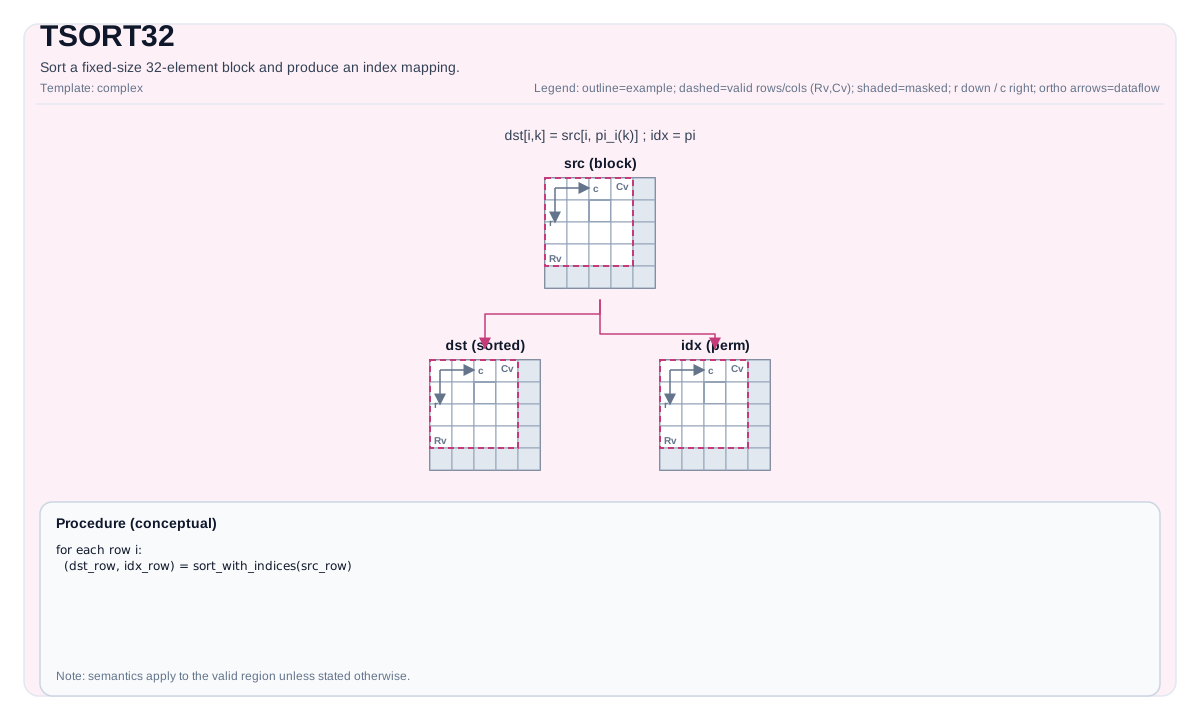
对 src 的每个32元素块,与 idx 中对应的索引一起进行排序,并将排序后的值-索引对写入 dst。底层SFU指令为 VBS32(vbitsort),单次调用可排序一个或多个独立的32元素列表。
硬件:VBS32(vbitsort)
VBS32运行在 SFU(非向量流水线)上。一次调用排序 repeat 个连续的32元素块,每个块由32个值 + 32个索引组成,打包为值-索引对:
void vbitsort(__ubuf__ T *dst,        // 排序后的值-索引对输出
              __ubuf__ T *src0,        // 每块 32 个值 × repeat
              __ubuf__ uint32_t *src1, // 每块 32 个索引 × repeat
              uint8_t repeat);         // 32 元素块的数量(1..255)
repeat(上限REPEAT_MAX = 255)打包到config[63:56]。- 块在内存中连续分布,步长为32个元素:块
b读取src0[b*32 : b*32+32]和src1[b*32 : b*32+32],写入dst[b*32*coef : ...],其中coef= 2(float)或4(half)——值-索引对的扩展因子。 - 排序顺序:按值降序;相同值时索引小者优先。
数学语义
对每一行 r,src 按独立的32元素块处理。设块 b 覆盖列 32b … 32b+31,n_b = min(32, C - 32b) 为其有效元素数。
按值降序排序,输出重排后的序列:
其中 π 为该块的排序置换。
注:
idx是输入Tile(索引随值一起被重排),不是输出。dst存储排序后的值-索引对,而非仅排序后的值。
C++内建接口
声明于 include/pto/common/pto_instr.hpp:
公共包含头为
<pto/pto-inst.hpp>,内部声明位于pto/common/pto_instr.hpp。
// 3 参数:src 必须 32 对齐(validCol % 32 == 0)
template <typename DstTileData, typename SrcTileData, typename IdxTileData>
PTO_INST RecordEvent TSort32(DstTileData &dst, SrcTileData &src, IdxTileData &idx);

// 4 参数:支持非 32 对齐尾部(validCol % 32 != 0),通过 tmp 填充
template <typename DstTileData, typename SrcTileData, typename IdxTileData, typename TmpTileData>
PTO_INST RecordEvent TSort32(DstTileData &dst, SrcTileData &src, IdxTileData &idx, TmpTileData &tmp);
Tile尺寸与数据类型
对于 src 形状为 \(R \times C\)(有效区域)、块大小32:
| Tile | dtype | 尺寸(元素数) | 说明 |
|---|---|---|---|
src |
half 或 float(\(T\)) |
\(R \times C\) | 待排序的值 |
idx |
uint32_t |
\(R \times C\)(或 \(1 \times C\) 广播) | 随值重排的索引 |
dst |
\(T\) | \(R \times (2C)\) float,\(R \times (4C)\) half | 排序后的值-索引对(见下方扩展因子) |
tmp(仅4参数) |
\(T\) | 见下方tmp尺寸公式 | 尾部填充scratch |
dst 扩展因子(typeCoef):每个输入元素生成一个8Byte的tuple [value (4Byte), index (4Byte)]——float 的value占满4Byte;half 的2Byte value零扩展至4Byte。因此 dst 恒为 \(C \times 8\) 字节。
| dtype | 每个 src 列对应的 dst 列数(dtype单位) |
tuple布局 | 字节/tuple |
|---|---|---|---|
float |
×2(2个float槽位) | [value_f32, index_u32] |
8 |
half |
×4(4个half槽位) | [value_f16, 0x0000, index_u32] |
8 |
约束
| 约束 | 原因 |
|---|---|
dst/src dtype = half 或 float(须一致);idx = uint32_t |
VBS32类型分派 |
所有Tile为 TileType::Vec、BLayout::RowMajor |
SFU寻址 |
validCol % 32 == 0(3参数) |
每块恰为32个元素 |
validCol 任意(4参数) |
尾块通过 tmp 填充至32,填充值为 \(-\infty\) |
repeat = validCol/32(3参数)或 ceil(validCol/32)(4参数) |
VBS32 repeat计数,每次调用 ≤ 255;更大的 validCol 拆分为多次 vbitsort 调用 |
tmp(4参数)≥ tmpSize 元素(见下方公式) |
保存填充后的行/尾块副本 |
无 WaitEvents&... / 无内部 TSYNC |
如需同步须显式调用 |
tmp 尺寸公式(4参数)
设 \(C\) = validCol,\(B\) = sizeof(T) 字节数,\(G\) = 32(块大小)。实现根据整行大小是否满足 MAX_UB_TMP = 8160 进行分支(Atlas A2/A3 训练系列产品/Atlas A2/A3 推理系列产品按元素数,Ascend 950PR/Ascend 950DT按字节数):
ceil_G(C)= \(C\) 向上取整到32的倍数。- Atlas A2/A3 训练系列产品/Atlas A2/A3 推理系列产品:阈值单位为元素数(
srcShapeBytesPerRow / sizeof(T) <= MAX_UB_TMP),即 \(C \le 8160\),与dtype无关(float → \(C \le 8160\),half → \(C \le 8160\))。 - Ascend 950PR/Ascend 950DT:阈值单位为字节(
srcShapeBytesPerRow <= MAX_UB_TMP),即 \(C \cdot b \le 8160\)(float → \(C \le 2040\),half → \(C \le 4080\))。该阈值为pto_copy_ubuf_to_ubuf(MOV_UB_TO_UB)的repeat上限 = 255块 × 32Byte。 - 尾块 = \(t = C \bmod G\) 个元素(末尾不完整块),扩展至 \(G\) 并以 \(-\infty\) 填充。
- Path A(\(C \cdot b \le 8160\),小行):从行首整行复制到tmp,然后原地填充最后32个元素。
- Path B(\(C \cdot b > 8160\),大行):仅复制尾块到tmp;完整块直接从
src排序。 - VBS32硬件上限:每次调用
repeat ≤ REPEAT_MAX = 255块(≤ 8160元素);超过255块的行拆分为多次vbitsort调用。 - UB布局:
tmp应放置在dst之后(32Byte对齐),大小为ceil(C·b, 32)字节(等价于ceil(ceil(C, 32)·b, 32),因 \(b \in \{2,4\}\) 整除32)——不应使用固定的8KB偏移,因为Path A(Atlas A2/A3 训练系列产品/Atlas A2/A3 推理系列产品)在接近阈值时对float需要最多 ~32KB(\(C \le 8160\) 元素 = float 32KB)。
4参数尾部处理
当 validCol % 32 != 0 时,末尾不完整块(\(t = C \bmod 32\) 个元素)须填充为完整的32元素块后才能送入 vbitsort。两条路径:
- Atlas A2/A3 训练系列产品/Atlas A2/A3 推理系列产品:\(C \le 8160\)(元素数) / Ascend 950PR/Ascend 950DT:\(C \cdot b \le 8160\)(字节)(小行):整行复制到
tmp,然后通过vdup原地覆盖最后32个元素为 \(-\infty\) 填充;从tmp排序整行。 - Atlas A2/A3 训练系列产品/Atlas A2/A3 推理系列产品:\(C > 8160\)(元素数) / Ascend 950PR/Ascend 950DT:\(C \cdot b > 8160\)(字节)(大行):仅复制尾块到
tmp并填充;完整块直接从src排序,仅尾块从tmp排序。
填充值(\(-\infty\) = -1.0/0.0 或 std::numeric_limits<T>::lowest())落在降序排序的底部。若 validCol > 32 × 255,行按 REPEAT_MAX 大小的组拆分,每组通过独立的 vbitsort 调用排序。
汇编语法
AS Level 1(SSA)
%dst = pto.tsort32 %src, %idx : (!pto.tile<...>, !pto.tile<...>) -> !pto.tile<...>
AS Level 2(DPS)
pto.tsort32 ins(%src, %idx : !pto.tile_buf<...>, !pto.tile_buf<...>) outs(%dst : !pto.tile_buf<...>)
示例
#include <pto/pto-inst.hpp>
using namespace pto;

// 32 对齐:每行单个块
using SrcT = Tile<TileType::Vec, float, 1, 32>;
using IdxT = Tile<TileType::Vec, uint32_t, 1, 32>;
using DstT = Tile<TileType::Vec, float, 1, 64>;   // 2× src 列数(float)
SrcT src; IdxT idx; DstT dst;
TSort32(dst, src, idx);

// 非 32 对齐尾部:4 参数 + tmp
using SrcT2 = Tile<TileType::Vec, half, 1, 100>;
using IdxT2 = Tile<TileType::Vec, uint32_t, 1, 100>;
using DstT2 = Tile<TileType::Vec, half, 1, 400>;  // 4× src 列数(half)
using TmpT  = Tile<TileType::Vec, half, 1, 128>;  // ≥ ceil32(100)=128
TSort32(dst2, src2, idx2, tmp);
ASM形式示例
Auto模式
%dst = pto.tsort32 %src, %idx : (!pto.tile<...>, !pto.tile<...>) -> !pto.tile<...>
Manual模式
# pto.tassign %arg0, @tile(0x1000)
# pto.tassign %arg1, @tile(0x2000)
# pto.tassign %arg2, @tile(0x3000)
%dst = pto.tsort32 %src, %idx : (!pto.tile<...>, !pto.tile<...>) -> !pto.tile<...>
PTO汇编形式
%dst = tsort32 %src, %idx : (!pto.tile<...>, !pto.tile<...>) -> !pto.tile<...>
# AS Level 2(DPS)
pto.tsort32 ins(%src, %idx : !pto.tile_buf<...>, !pto.tile_buf<...>) outs(%dst : !pto.tile_buf<...>)