TROWARGMAX
Tile Operation Diagram
Introduction
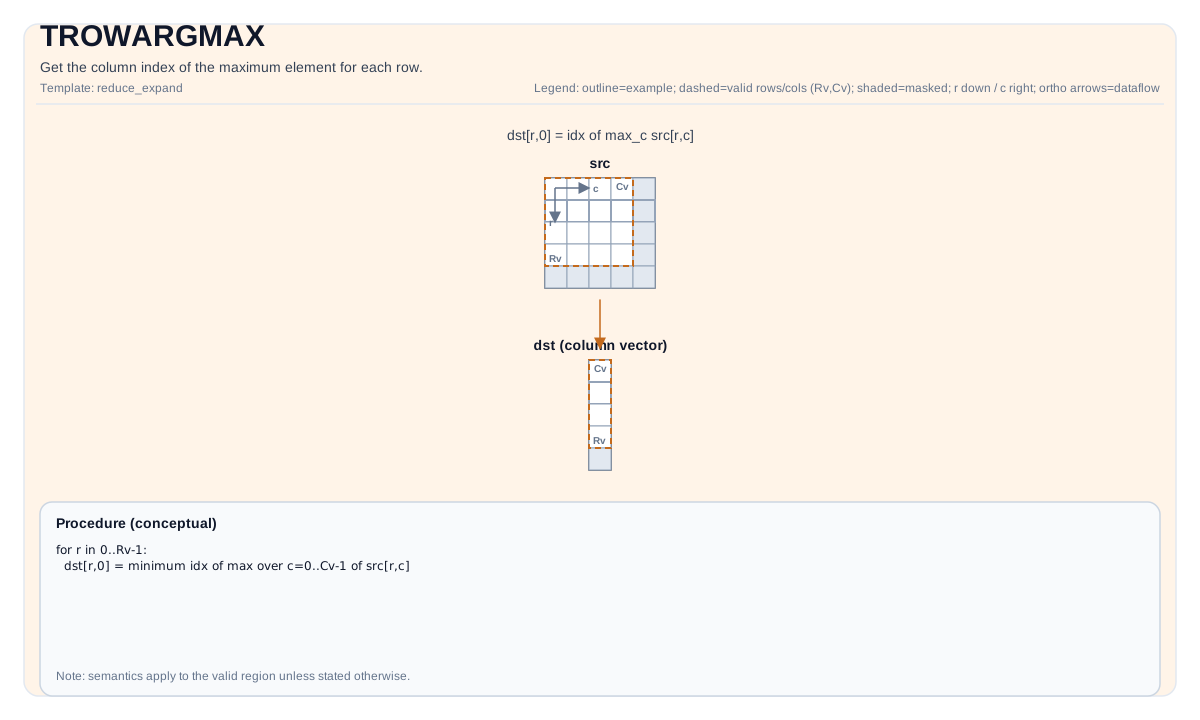
Get the column index of the maximum element, or both value and column index of the maximum element for each row.
Math Interpretation
Let R = src.GetValidRow() and C = src.GetValidCol(). For 0 <= i < R:
\[ \mathrm{dst}_{i,0} = \underset{0 \le j < C}{\operatorname{argmax}} \; \mathrm{src}_{i,j} \]
\[ \mathrm{dstval}_{i,0} = \max_{0 \le j < C} \mathrm{src}_{i,j} \]
Assembly Syntax
Synchronous form:
%dst = trowargmax %src : !pto.tile<...> -> !pto.tile<...>
Lowering may introduce internal scratch tiles; the C++ intrinsic requires an explicit tmp operand.
IR Level 1 (SSA)
%dst = pto.trowargmax %src, %tmp : (!pto.tile<...>, !pto.tile<...>) -> !pto.tile<...>
IR Level 2 (DPS)
pto.trowargmax ins(%src, %tmp : !pto.tile_buf<...>, !pto.tile_buf<...>) outs(%dst : !pto.tile_buf<...>)
C++ Intrinsic
Declared in include/pto/common/pto_instr.hpp:
Output index only:
template <typename TileDataOut, typename TileDataIn, typename TileDataTmp, typename... WaitEvents>
PTO_INST RecordEvent TROWARGMAX(TileDataOut& dst, TileDataIn& src, TileDataTmp& tmp, WaitEvents&... events);
Output both value and index:
template <typename TileDataOutVal, typename TileDataOutIdx, typename TileDataIn, typename TileDataTmp,
          typename... WaitEvents>
PTO_INST RecordEvent TROWARGMAX(TileDataOutVal &dstVal, TileDataOutIdx &dstIdx, TileDataIn &src, TileDataTmp &tmp,
                                WaitEvents &... events)
Constraints
General constraints / checks
- Supported source element types:
half,float,int32_t,int16_t(A2A3). On A5 any 2-/4-byte source is accepted (half,bfloat16_t,int16_t,uint16_t,float,int32_t,uint32_t). srcmust use standard ND layout: row-major and non-fractal (BLayout::RowMajor,SLayout::NoneBox).- When output index only:
dstandsrcmust beTileType::Vec.- Supported destination element types:
uint32_t,int32_t. - Runtime checks follow the shared row-reduce check path:
src.GetValidRow() != 0src.GetValidCol() != 0src.GetValidRow() == dst.GetValidRow()
dstis checked through the shared row-reduce-index path and may use either of these non-fractal layouts:- DN layout with one column (
BLayout::ColMajor,Cols == 1), or - ND layout whose valid column count is 1.
- DN layout with one column (
- When output both value and index:
dstVal,dstIdx,srcmust beTileType::Vec.- Supported destination element types:
uint32_t,int32_t. - Runtime checks follow the shared row-reduce check path:
src.GetValidRow() != 0src.GetValidCol() != 0src.GetValidRow() == dstIdx.GetValidRow()src.GetValidRow() == dstVal.GetValidRow()
dstVal,dstIdxare checked through the shared row-reduce-index path and may use either of these non-fractal layouts:- DN layout with one column (
BLayout::ColMajor,Cols == 1), or - ND layout whose valid column count is 1.
- DN layout with one column (
About temporary tile tmp
- Temporary tile is only used by A2A3, A5 accepts
tmptile but leaves it unused. - The A2A3 implementation selects one of three code paths based on
srcValidColrelative toelementPerRepeat(abbreviatedelemPerRptbelow):
Case 1: srcValidCol <= elemPerRpt
- Index-only mode:
tmpis not used. The hardwarevcmaxinstruction writes directly todst. - Value + Index mode:
tmpis used as a small buffer (2 elements per row: one value + one index).tmpmay use either of these non-fractal layouts:- DN layout with one column (
BLayout::ColMajor,Cols == 1), rows is twice ofsrc. - ND layout whose valid column count is 2, rows is the same as
src.
- DN layout with one column (
Case 2: elemPerRpt < srcValidCol <= elemPerRpt² (Stage 1 reduction)
tmpis used for a single-stage reduction.- Rows of
tmptile is equal tosrc. tmptile's stride per row can be calculated using:
R1 = ceil(validCol / elemPerRpt)
stride = (ceil(R1 * 2 / elemPerBlock) + ceil(R1 / elemPerBlock)) * elemPerBlock
Case 3: srcValidCol > elemPerRpt² (Stage 2 reduction)
tmpis used for a two-stage reduction, requiring more space than Stage 1.- Rows of
tmptile is equal tosrc. tmptile's stride per row can be calculated using:
R1 = ceil(validCol / elemPerRpt)
R2 = ceil(R1 / elemPerRpt)
stage1_size = ceil(R1 * 2 / elemPerBlock) * elemPerBlock
stage2_end  = ceil(R1 / elemPerBlock) * elemPerBlock + ceil(R2 * 2 / elemPerBlock) * elemPerBlock
stride = max(stage1_size, stage2_end) + 2
- The
+ 2accounts for the final value + index result stored at the end of each row's tmp region.
Examples
Auto
#include <pto/pto-inst.hpp>

using namespace pto;

void example_auto() {
  using SrcT = Tile<TileType::Vec, float, 16, 16>;
  using DstT = Tile<TileType::Vec, uint32_t, 16, 1, BLayout::ColMajor>;
  using DstValT = Tile<TileType::Vec, float, 16, 1, BLayout::ColMajor>;
  using TmpT = Tile<TileType::Vec, float, 16, 16>;
  SrcT src;
  DstT dst;
  DstValT dst;
  TmpT tmp;
  TROWARGMAX(dst, src, tmp);
  TROWARGMAX(dstVal, dst, src, tmp);
}
Manual
#include <pto/pto-inst.hpp>

using namespace pto;

void example_manual() {
  using SrcT = Tile<TileType::Vec, float, 16, 16>;
  using DstT = Tile<TileType::Vec, uint32_t, 16, 1, BLayout::ColMajor>;
  using DstValT = Tile<TileType::Vec, float, 16, 1, BLayout::ColMajor>;
  using TmpT = Tile<TileType::Vec, float, 16, 16>;
  SrcT src;
  DstT dst;
  DstValT dst;
  TmpT tmp;
  TASSIGN(src, 0x1000);
  TASSIGN(dst, 0x2000);
  TASSIGN(dstVal, 0x3000);
  TASSIGN(tmp, 0x4000);
  TROWARGMAX(dst, src, tmp);
  TROWARGMAX(dstVal, dst, src, tmp);
}
ASM Form Examples
Auto Mode
# Auto mode: compiler/runtime-managed placement and scheduling.
%dst = pto.trowmax %src, %tmp : (!pto.tile<...>, !pto.tile<...>) -> !pto.tile<...>
Manual Mode
# Manual mode: resources must be bound explicitly before issuing the instruction.
# Optional for tile operands:
# pto.tassign %arg0, @tile(0x1000)
# pto.tassign %arg1, @tile(0x2000)
%dst = pto.trowmax %src, %tmp : (!pto.tile<...>, !pto.tile<...>) -> !pto.tile<...>
PTO Assembly Form
%dst = trowmax %src : !pto.tile<...> -> !pto.tile<...>
# IR Level 2 (DPS)
pto.trowmax ins(%src, %tmp : !pto.tile_buf<...>, !pto.tile_buf<...>) outs(%dst : !pto.tile_buf<...>)