TPOW
Tile Operation Diagram
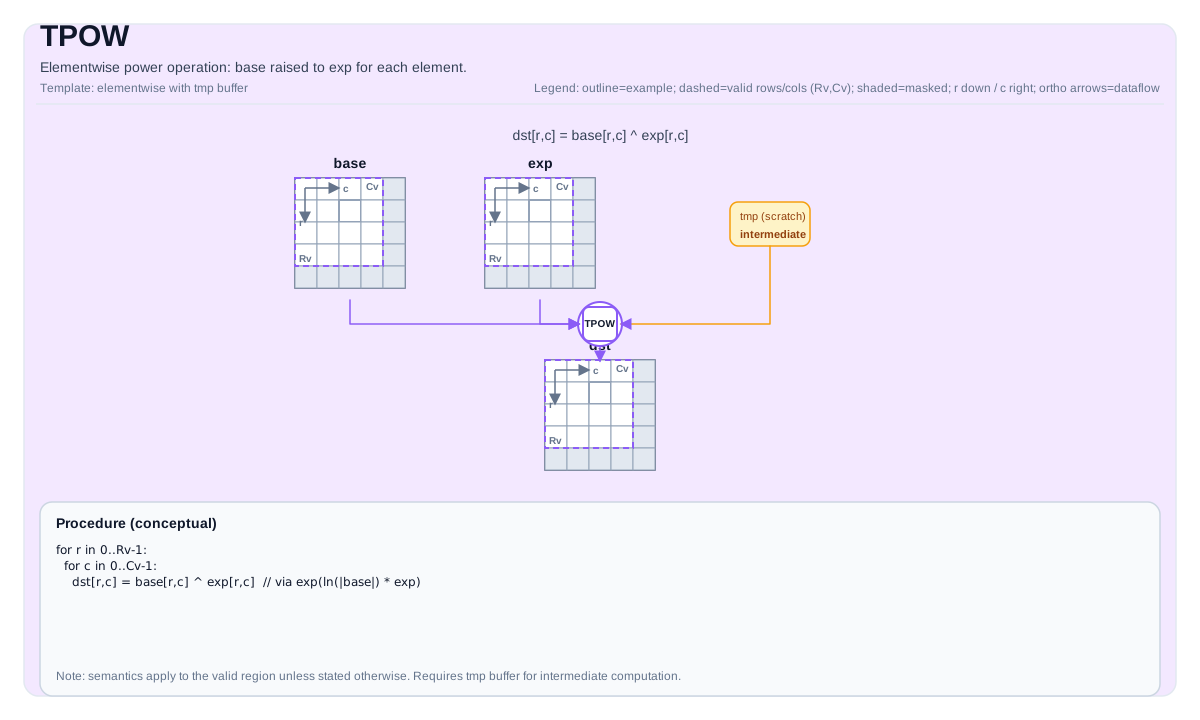
Introduction
Elementwise power operation: computes base raised to the power of exp for each element.
Math Interpretation
For each element (i, j) in the valid region:
\[ \mathrm{dst}_{i,j} = \mathrm{base}_{i,j}^{\mathrm{exp}_{i,j}} \]
For floating-point types, the computation follows: dst = exp(ln(|base|) * exp) with special case handling for negative base values and integer exponents.
Assembly Syntax
Synchronous form:
%dst = tpow %base, %exp, %tmp : !pto.tile<...>
AS Level 1 (SSA)
%dst = pto.tpow %base, %exp, %tmp : (!pto.tile<...>, !pto.tile<...>, !pto.tile<...>) -> !pto.tile<...>
AS Level 2 (DPS)
pto.tpow ins(%base, %exp, %tmp : !pto.tile_buf<...>, !pto.tile_buf<...>, !pto.tile_buf<...>) outs(%dst : !pto.tile_buf<...>)
C++ Intrinsic
Declared in include/pto/common/pto_instr.hpp:
template <auto PrecisionType = PowAlgorithm::DEFAULT, typename DstTile, typename BaseTile, typename ExpTile,
          typename TmpTile, typename... WaitEvents>
PTO_INTERNAL RecordEvent TPOW(DstTile &dst, BaseTile &base, ExpTile &exp, TmpTile &tmp, WaitEvents &... events);
PrecisionType has the following values available:
PowAlgorithm::DEFAULT: Normal algorithm, faster but with lower precision.PowAlgorithm::HIGH_PRECISION: High precision algorithm, but slower.
Constraints
General Constraints
dst,base, andexpmust all beTileType::Vec.- All tiles must use row-major layout (
TileData::isRowMajor). dst,base, andexpmust have the same element type.- Static valid bounds:
TileData::ValidRow <= TileData::RowsandTileData::ValidCol <= TileData::Cols. - Runtime valid region checks:
dst.GetValidRow() == base.GetValidRow()dst.GetValidCol() == base.GetValidCol()dst.GetValidRow() == exp.GetValidRow()dst.GetValidCol() == exp.GetValidCol()
- The intrinsic signature requires an explicit
tmpoperand.
A2A3 Implementation Checks
- Supported element types:
int32_t,int16_t,int8_t,uint32_t,uint16_t,uint8_t,float. HIGH_PRECISIONalgorithm is not supported on A2A3;PrecisionTypeoption is ignored.- Additional runtime valid region checks for
tmp:dst.GetValidRow() == tmp.GetValidRow()dst.GetValidCol() == tmp.GetValidCol()
A5 Implementation Checks
- For
DEFAULTalgorithm: supported element types areuint8_t,int8_t,uint16_t,int16_t,uint32_t,int32_t,half,float,bfloat16_t. - For
HIGH_PRECISIONalgorithm: supported element types arehalf,float,bfloat16_t(floating-point only). - Integer types use a separate integer power computation path.
Temporary Space
A2A3
- For floating-point types (
float):tmpis used as intermediate scratch storage. The implementation computespow(base, exp) = exp(ln(|base|) * exp)and usestmpto store theexp(ln(|base|) * exp)result with absolute value for special-case handling (negative base with odd integer exponent). tmpmust have the same element type asdst/base/exp.tmp.GetValidRow() >= dst.GetValidRow()andtmp.GetValidCol() >= dst.GetValidCol().- For integer types:
tmpis not used. The integer power path uses scalar computation without scratch tile storage.
A5
tmp is accepted by the interface but not used by the A5 implementation. The A5 backend uses vector register-based computation and does not require scratch tile storage. tmp is retained in the C++ intrinsic signature solely for API compatibility with A2A3.
Examples
Auto
#include <pto/pto-inst.hpp>

using namespace pto;

void example_auto() {
  using TileT = Tile<TileType::Vec, float, 16, 16>;
  TileT base, exp, dst, tmp;
  TPOW(dst, base, exp, tmp);
  TPOW<PowAlgorithm::HIGH_PRECISION>(dst, base, exp, tmp);
}
Manual
#include <pto/pto-inst.hpp>

using namespace pto;

void example_manual() {
  using TileT = Tile<TileType::Vec, float, 16, 16>;
  TileT base, exp, dst, tmp;
  TASSIGN(base, 0x1000);
  TASSIGN(exp, 0x2000);
  TASSIGN(dst, 0x3000);
  TASSIGN(tmp, 0x4000);
  TPOW(dst, base, exp, tmp);
}
ASM Form Examples
Auto Mode
# Auto mode: compiler/runtime-managed placement and scheduling.
%dst = pto.tpow %base, %exp, %tmp : (!pto.tile<...>, !pto.tile<...>, !pto.tile<...>) -> !pto.tile<...>
Manual Mode
# Manual mode: resources must be bound explicitly before issuing the instruction.
# Optional for tile operands:
# pto.tassign %arg0, @tile(0x1000)
# pto.tassign %arg1, @tile(0x2000)
# pto.tassign %arg2, @tile(0x3000)
%dst = pto.tpow %base, %exp, %tmp : (!pto.tile<...>, !pto.tile<...>, !pto.tile<...>) -> !pto.tile<...>
PTO Assembly Form
%dst = tpow %base, %exp, %tmp : !pto.tile<...>
# AS Level 2 (DPS)
pto.tpow ins(%base, %exp, %tmp : !pto.tile_buf<...>, !pto.tile_buf<...>, !pto.tile_buf<...>) outs(%dst : !pto.tile_buf<...>)