TCOLARGMIN
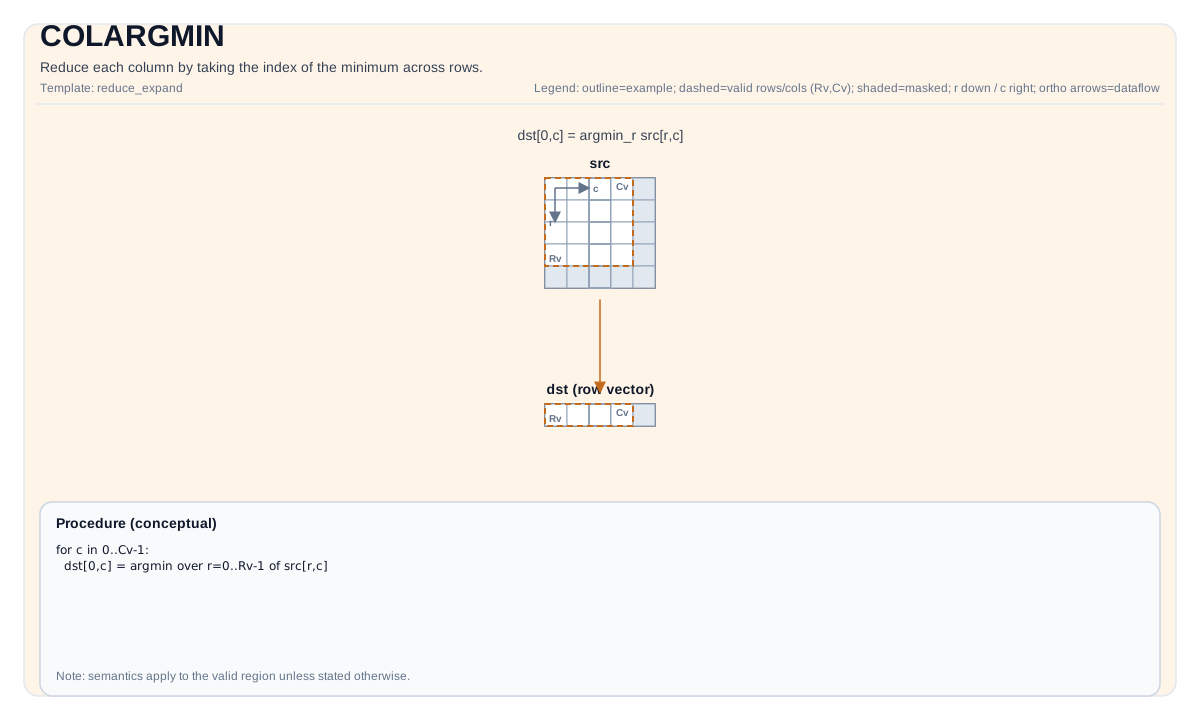
Tile Operation Diagram
Introduction
Get the row index of the minimum element for each column. A value+index variant is also available that returns both the minimum value and its row index.
Math Interpretation
Pure Index Mode
Let R = src.GetValidRow() and C = src.GetValidCol(). For 0 <= j < C:
\[ \mathrm{dstIdx}_{0,j} = \underset{0 \le i < R}{\operatorname{argmin}} \; \mathrm{src}_{i,j} \]
Value + Index Mode
\[ \mathrm{dstVal}_{0,j} = \min_{0 \le i < R} \mathrm{src}_{i,j} \]
\[ \mathrm{dstIdx}_{0,j} = \underset{0 \le i < R}{\operatorname{argmin}} \; \mathrm{src}_{i,j} \]
Assembly Syntax
Pure Index Mode
Synchronous form:
%dstIdx = tcolargmin %src : !pto.tile<...> -> !pto.tile<...>
IR Level 1 (SSA):
%dstIdx = pto.tcolargmin %src, %tmp : (!pto.tile<...>, !pto.tile<...>) -> !pto.tile<...>
IR Level 2 (DPS):
pto.tcolargmin ins(%src, %tmp : !pto.tile_buf<...>, !pto.tile_buf<...>) outs(%dstIdx : !pto.tile_buf<...>)
Value + Index Mode
Synchronous form:
%dstVal, %dstIdx = tcolargmin %src : !pto.tile<...> -> !pto.tile<...>, !pto.tile<...>
IR Level 1 (SSA):
%dstVal, %dstIdx = pto.tcolargmin %src, %tmp : (!pto.tile<...>, !pto.tile<...>) -> (!pto.tile<...>, !pto.tile<...>)
IR Level 2 (DPS):
pto.tcolargmin ins(%src, %tmp : !pto.tile_buf<...>, !pto.tile_buf<...>) outs(%dstVal, %dstIdx : !pto.tile_buf<...>, !pto.tile_buf<...>)
C++ Intrinsic
Declared in include/pto/common/pto_instr.hpp:
Pure Index Mode (3-argument)
template <typename TileDataOut, typename TileDataIn, typename TileDataTmp, typename... WaitEvents>
PTO_INST RecordEvent TCOLARGMIN(TileDataOut &dst, TileDataIn &src, TileDataTmp &tmp, WaitEvents &...events)
Value + Index Mode (4-argument)
template <typename TileDataOutVal, typename TileDataOutIdx, typename TileDataIn, typename TileDataTmp,
          typename... WaitEvents>
PTO_INST RecordEvent TCOLARGMIN(TileDataOutVal& dstVal, TileDataOutIdx& dstIdx, TileDataIn& src, TileDataTmp& tmp,
                                WaitEvents&... events);
Constraints
General constraints / checks
dstIdxandsrcmust beTileType::Vec.srcmay use ND or DN non-fractal layout (SLayout::NoneBox).dstIdxmust use standard ND layout: row-major and non-fractal (BLayout::RowMajor,SLayout::NoneBox).- Supported destination index element types:
uint32_t,int32_t. - Runtime checks:
src.GetValidRow() != 0src.GetValidCol() != 0dstIdx.GetValidRow() == 1src.GetValidCol() == dstIdx.GetValidCol()
Pure Index Mode (3-argument)
A2A3 implementation checks
- Supported source element types:
half,float,uint16_t,uint32_t. tmpmust use the same element type assrc.tmpis used as scratch storage for index tracking and current comparison values.
A5 implementation checks
- Supported source element sizes are 8-bit, 16-bit, or 32-bit; covers
int8_t,uint8_t,int16_t,uint16_t,int32_t,uint32_t,half,float. tmpis accepted by the interface but not used by the implementation.
Value + Index Mode (4-argument)
In addition to the general constraints:
dstValmust beTileType::Vecwith standard ND layout (row-major, non-fractal).dstValelement type must match the source element typeTileDataIn::DType.- 8-bit source types are not supported.
- Runtime checks:
dstVal.GetValidRow() == 1dstVal.GetValidCol() != 0src.GetValidCol() == dstVal.GetValidCol()dstVal.GetValidRow() == dstIdx.GetValidRow()dstVal.GetValidCol() == dstIdx.GetValidCol()
A2A3 implementation checks
- Supported source element types:
half,float,uint16_t,uint32_t. - When source element size is 2 bytes (
half,uint16_t):dstIdxelement type must beuint16_torint16_t. - When source element size is 4 bytes (
float,uint32_t):dstIdxelement type must beuint32_torint32_t. tmpmust use the same element type assrc.tmpis used as scratch storage; for half input types an internal s16->f16->s32 conversion path is used for the index.
A5 implementation checks
- Source element size must be 16-bit or 32-bit (
sizeof(T) != 1). - When source element size is 2 bytes (
half,int16_t,uint16_t):dstIdxelement type must beuint16_torint16_t. - When source element size is 4 bytes (
float,int32_t,uint32_t):dstIdxelement type must beuint32_torint32_t. tmpis accepted by the interface but not used by the implementation.
About temporary tile tmp for A2A3
tmpis always used in the A2A3 implementation, but the extent of usage depends on the source element type and mode:
| Source type | Mode | Region 0 (row index) | Region 1 (comparison values) | Region 2 (argmin index) |
|---|---|---|---|---|
half |
Pure Index | tmp |
tmp |
tmp |
half |
Value + Index | tmp |
tmp |
dstIdx |
float |
Pure Index | tmp |
dstIdx |
dstIdx |
float |
Value + Index | tmp |
dstIdx |
dstIdx |
tmptile's data type must be the same assrc's data type.tmptile is organized into up to three regions within a single row:- Region 0 (
[0, tmpGapEles)): current row index counter (incremented per row). Always stored intmp. - Region 1 (
[tmpGapEles, 2 * tmpGapEles)): current minimum elements for comparison. Stored intmpforhalftype; stored indstIdxforfloattype. - Region 2 (
[2 * tmpGapEles, 3 * tmpGapEles)): argmin index result. Stored intmponly forhalf+ Pure Index mode; stored indstIdxotherwise. tmpGapElesis determined as follows:- When
srcValidCol >= elemPerRpt:tmpGapEles = elemPerRpt. - When
srcValidCol < elemPerRpt:tmpGapEles = ceil(srcValidCol / elemPerBlock) * elemPerBlock. - For
half+ Pure Index mode (maximumtmpusage), simply settmptile size the same assrcwhensrcis small, or calculate the requiredtmpstride using:
text
  repeats = ceil(validCol / elementPerRepeat)
  stride = ceil(repeats * 2 / elementPerBlock) * elementPerBlock + ceil(repeats / elementPerBlock) * elementPerBlock
For other type/mode combinations, only Region 0 is required in tmp, so tmp stride of tmpGapEles suffices.
- In Pure Index mode with
halfinput,tmpregion 2 data undergoes s16->f16->s32 conversion before being stored todstIdx.
About temporary tile tmp for A5
tmptemporary tile is not used in the A5 implementation for either mode. The A5 uses vector register-based computation (__VEC_SCOPE__) and does not require scratch tile storage.tmpis retained in the C++ intrinsic signature solely for API compatibility with A2A3.
Examples
Pure Index Mode
Auto
#include <pto/pto-inst.hpp>

using namespace pto;

void example_auto() {
  using SrcT = Tile<TileType::Vec, float, 16, 256, BLayout::RowMajor, -1, -1>;
  using DstT = Tile<TileType::Vec, uint32_t, 1, 256, BLayout::RowMajor, -1, -1>;
  using TmpT = Tile<TileType::Vec, float, 1, 32, BLayout::RowMajor, -1, -1>;
  SrcT src(16, 255);
  DstT dst(1, 255);
  TmpT tmp(1, 32);
  TCOLARGMIN(dst, src, tmp);
}
Manual
#include <pto/pto-inst.hpp>

using namespace pto;

void example_manual() {
  using SrcT = Tile<TileType::Vec, float, 16, 256, BLayout::RowMajor, -1, -1>;
  using DstT = Tile<TileType::Vec, uint32_t, 1, 256, BLayout::RowMajor, -1, -1>;
  using TmpT = Tile<TileType::Vec, float, 1, 32, BLayout::RowMajor, -1, -1>;
  SrcT src(16, 255);
  DstT dst(1, 255);
  TmpT tmp(1, 32);
  TASSIGN(src, 0x0);
  TASSIGN(dst, 0x1000);
  TASSIGN(tmp, 0x2000);
  TCOLARGMIN(dst, src, tmp);
}
Value + Index Mode
Auto
#include <pto/pto-inst.hpp>

using namespace pto;

void example_auto_val_idx() {
  using SrcT = Tile<TileType::Vec, float, 16, 256, BLayout::RowMajor, -1, -1>;
  using DstValT = Tile<TileType::Vec, float, 1, 256, BLayout::RowMajor, -1, -1>;
  using DstIdxT = Tile<TileType::Vec, int32_t, 1, 256, BLayout::RowMajor, -1, -1>;
  using TmpT = Tile<TileType::Vec, float, 1, 32, BLayout::RowMajor, -1, -1>;
  SrcT src(16, 255);
  DstValT dstVal(1, 255);
  DstIdxT dstIdx(1, 255);
  TmpT tmp(1, 32);
  TCOLARGMIN(dstVal, dstIdx, src, tmp);
}
Manual
#include <pto/pto-inst.hpp>

using namespace pto;

void example_manual_val_idx() {
  using SrcT = Tile<TileType::Vec, float, 16, 256, BLayout::RowMajor, -1, -1>;
  using DstValT = Tile<TileType::Vec, float, 1, 256, BLayout::RowMajor, -1, -1>;
  using DstIdxT = Tile<TileType::Vec, int32_t, 1, 256, BLayout::RowMajor, -1, -1>;
  using TmpT = Tile<TileType::Vec, float, 1, 32, BLayout::RowMajor, -1, -1>;
  SrcT src(16, 255);
  DstValT dstVal(1, 255);
  DstIdxT dstIdx(1, 255);
  TmpT tmp(1, 32);
  TASSIGN(src, 0x0);
  TASSIGN(dstVal, 0x1000);
  TASSIGN(dstIdx, 0x2000);
  TASSIGN(tmp, 0x3000);
  TCOLARGMIN(dstVal, dstIdx, src, tmp);
}
ASM Form Examples
Pure Index Auto Mode
# Auto mode: compiler/runtime-managed placement and scheduling.
%dstIdx = pto.tcolargmin %src, %tmp : (!pto.tile<...>, !pto.tile<...>) -> !pto.tile<...>
Pure Index Manual Mode
# Manual mode: resources must be bound explicitly before issuing the instruction.
# pto.tassign %arg0, @tile(0x1000)
# pto.tassign %arg1, @tile(0x2000)
%dstIdx = pto.tcolargmin %src, %tmp : (!pto.tile<...>, !pto.tile<...>) -> !pto.tile<...>
Value + Index Auto Mode
# Auto mode: compiler/runtime-managed placement and scheduling.
%dstVal, %dstIdx = pto.tcolargmin %src, %tmp : (!pto.tile<...>, !pto.tile<...>) -> (!pto.tile<...>, !pto.tile<...>)
Value + Index Manual Mode
# Manual mode: resources must be bound explicitly before issuing the instruction.
# pto.tassign %arg0, @tile(0x1000)
# pto.tassign %arg1, @tile(0x2000)
# pto.tassign %arg2, @tile(0x3000)
%dstVal, %dstIdx = pto.tcolargmin %src, %tmp : (!pto.tile<...>, !pto.tile<...>) -> (!pto.tile<...>, !pto.tile<...>)
PTO Assembly Form
# Pure index
%dstIdx = tcolargmin %src : !pto.tile<...> -> !pto.tile<...>
# Value + index
%dstVal, %dstIdx = tcolargmin %src : !pto.tile<...> -> !pto.tile<...>, !pto.tile<...>

# IR Level 2 (DPS) - pure index
pto.tcolargmin ins(%src, %tmp : !pto.tile_buf<...>, !pto.tile_buf<...>) outs(%dstIdx : !pto.tile_buf<...>)

# IR Level 2 (DPS) - value + index
pto.tcolargmin ins(%src, %tmp : !pto.tile_buf<...>, !pto.tile_buf<...>) outs(%dstVal, %dstIdx : !pto.tile_buf<...>, !pto.tile_buf<...>)